

Who Should Report a Near Miss in the Workplace?
A great question popped up recently on Safety Knights, and it got a lot of us thinking.
Bapi Sarkar asked:
“Who should report a near miss in the workplace?”
Simple question, right? But it’s one of those that reveals a lot about how your safety culture is really functioning.
If you want to keep this conversation going with other safety pros, the community is here:
https://safetyknights.com/
Bapi gave four possible answers in his poll:
- Only Supervisors and Managers
- Only Safety Officers
- Any Employee Who Witnesses or is Involved in the Event
- Only External Auditors
Let’s break these down—pros, cons, and the “why” behind the best answer.
Option 1: Only Supervisors and Managers
Pro: Supervisors are usually on the front lines and in the chain of command. They’re often the first to respond when something goes sideways.
Con: Relying only on supervisors to report near misses assumes they always see everything or that employees will tell them. Newsflash: they don’t—and they won’t. If the culture says “let the boss handle it,” you’re likely missing early warning signs that others are noticing.
This is where strong observation habits help, because you’re building a system that catches weak signals early, not just after the fact:
Safety Knights observation reporting post: https://safetyknights.com/post/67b813491bdca20015027583/the_power_of_observation_reporting_unlocking_valuable_insights_test
_
Option 2: Only Safety Officers
Pro: Safety officers are trained to assess, document, and respond to incidents. Their job is literally workplace safety.
Con: But again, they’re not everywhere, all the time. If near misses only flow through the safety team, you're risking delays—or worse, silence. And let’s be real, in many orgs, safety officers are stretched thin.
Also, there’s a subtle message here: “Only the safety team is responsible for safety.” That’s a recipe for disengagement and finger-pointing.
If you’re trying to grow a stronger safety culture (not just a stronger reporting process), the Safety Knights Content Center has resources you can pull from for toolbox talks, coaching, and programs:
Safety Knights Content Center: https://safetyknights.com/content/
Option 3: Any Employee Who Witnesses or Is Involved in the Event
Pro: This is the best-case scenario. Everyone in the workplace becomes part of the safety net.
Whether it’s a forklift nearly backing into someone, or a loose wire spotted by a temp employee—every pair of eyes matters. Near misses are chances to act before someone ends up on a reportable.
Con: The only downside is that it only works if people feel comfortable speaking up. That means no fear of blame, no complicated forms, and no eye-rolls from supervisors when someone says, “Hey, I saw something.”
This is also where day-to-day routines matter. When safety meetings are done well, they create space for people to speak up and surface near misses before they become injuries:
Safety Knights on safety meetings vs training: https://safetyknights.com/post/684d6dfef3ddd95c73eacfb9/hands_on_training_vs_safety_meetings_weighing_the_real_impact
Option 4: Only External Auditors
Pro: Paper trail.
Con: External auditors are not part of your day-to-day prevention system. If you’re relying on them to catch near misses, the problem is already out of hand. It’s like calling the health inspector after you’ve served spoiled food.
So What’s the Right Answer?
Answer: #3 – Any employee who witnesses or is involved in the event.
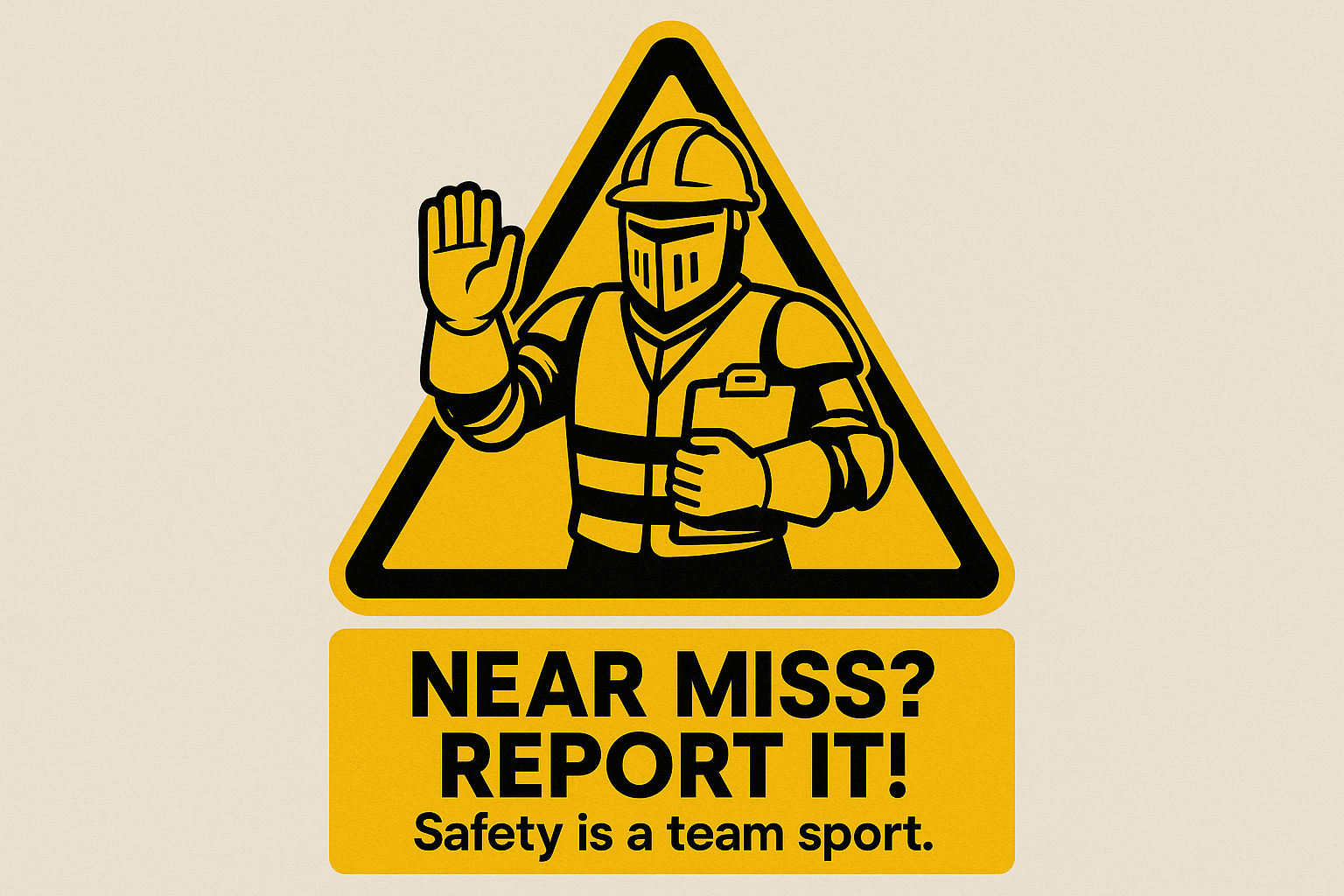
Why? Because safety isn’t a job title—it’s a team sport. When everyone has the responsibility and the permission to report near misses, your organization is learning from close calls instead of reacting to injuries.
Reporting near misses should be:
- Encouraged
- Easy
- Blame-free
- Rewarded
Need backup?
National Safety Council near-miss reporting: https://www.nsc.org/workplace/resources/near-miss-reporting
OSHA hazard identification (Recommended Practices): https://www.osha.gov/safety-management/hazard-Identification
If your organization’s only tracking recordables, you’re already behind. Leading indicators like near misses are where real improvement starts.
Is There a Better Answer?
Actually, yeah.
While “any employee who witnesses or is involved” is the correct answer, a world-class safety culture goes one step further.
Everyone not only can report near misses—they’re expected to. And the system makes it effortless.
A better answer to “Who should you report a near miss to?” might look like this:
“You report it through a simple, digital system that instantly notifies your supervisor, the safety team, and logs it for trend analysis. And if you’re not sure? You tell someone immediately—because speaking up is always the right move here.”
In elite safety cultures:
The process is fast, accessible, and available on mobile
Anonymous reporting is allowed, but rarely used—because trust is high
Frontline workers get feedback on their reports
Leadership thanks people for reporting—even when it’s inconvenient
If you’re exploring how tech can reduce friction (without turning reporting into a chore), this thread is a good starting point:
Safety Knights on automation and modern EHS platforms: https://safetyknights.com/post/68a9f10f64ea867c79dec588/the_ai_automation_level_up_what_safety_professionals_need_to_know
What This Says About Your Safety Culture
If you walk onto a site and ask a random worker, “Who do you report a near miss to?”—what answer do you get?
If it’s hesitation, confusion, or a nervous laugh, that’s a red flag.
Great safety cultures make the answer obvious. They:
Train everyone to know how and when to report
Use tech tools that make reporting fast and simple
Encourage near-miss reporting without punishment
Share feedback so people know their report mattered
It’s not about tattling. It’s about protecting each other.
And when people start looking out for each other, not just checking boxes, that’s when safety becomes real.
Contractor-heavy sites can be a good “culture test,” because contractors often expose weak systems through close calls. This post connects those dots:
Safety Knights contractors and near misses: https://safetyknights.com/post/688e110f3454bc0bb42ef39f/contractors_safety_risk_or_untapped_ally
_
Final Thought
Bapi’s question nailed something we don’t talk about enough: it’s not just what gets reported — it’s who feels responsible to speak up.
So let’s ask:
Does your team know it’s their job to report near misses?
And more importantly — do they feel safe doing it?
Drop your thoughts in the comments. Share how your site handles it. Let’s keep learning from each other—just like Bapi helped us do—and make this workplace safety community amazing.
If you want to see how other safety pros talk about leading indicators (including near misses) across different risk areas, this is a solid example:
Safety Knights on tracking near misses as indicators: https://safetyknights.com/post/6906111f25748fc628c5e668/the_ripple_effects_of_fleet_safety_on_company_wide_risk_management
Comments (2)

Everywhere I've worked we've tried to make it as simple as possible to report any & everything - to a supervisor, EHS, any manager - even HR! We have had to instill in personnel that there would never be repercussions for reporting & the goal is to make the workplace safer.

This a fantastic question for all safety pros to ask at their respective sites. If you're not receiving the correct answer, that's an immediate training opportunity!