

Branden Raczkowski
Nov 15, 2025
149
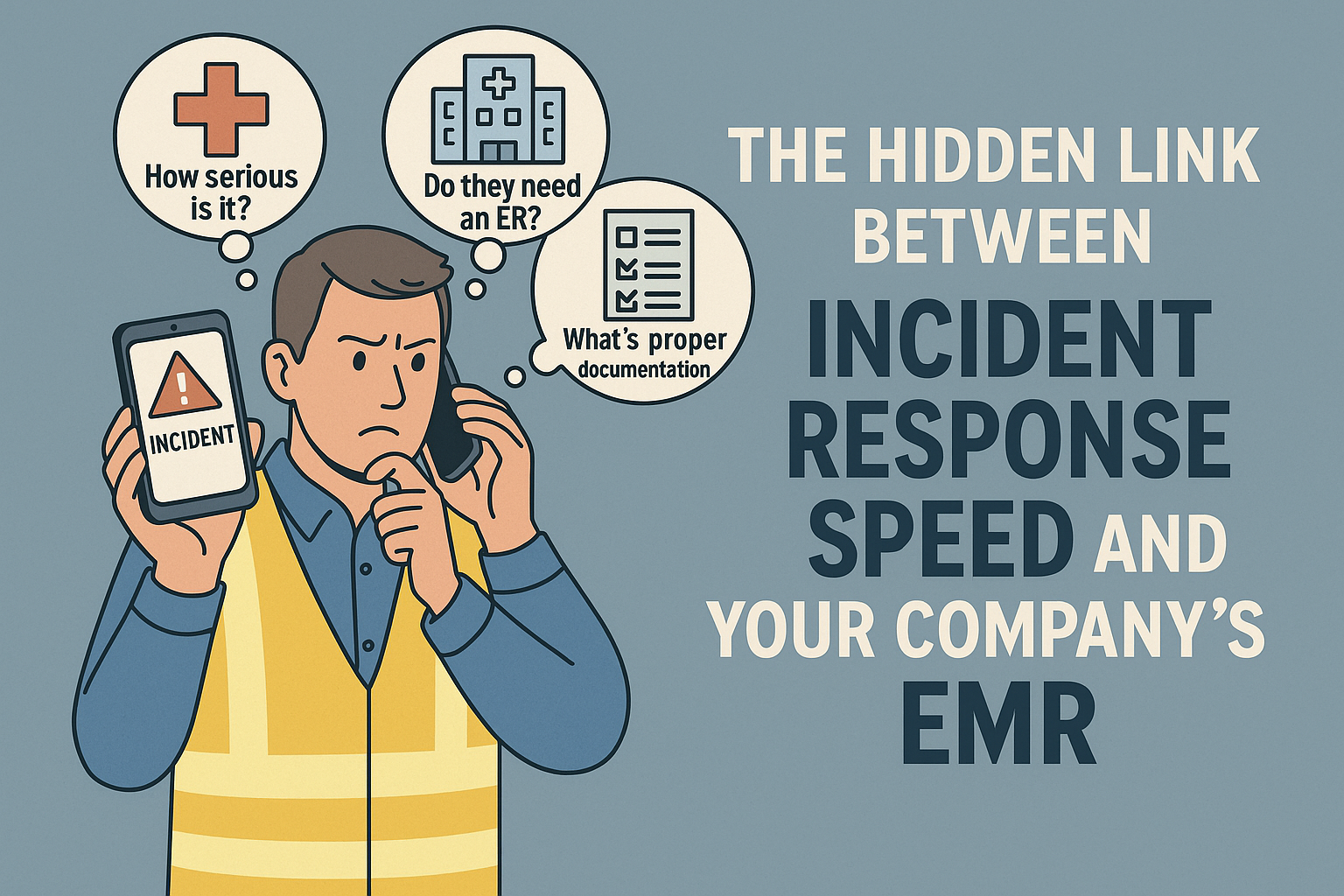
The Hidden Link Between Incident Response Speed and Your Company’s EMR
As a safety professional, you know that moment: your phone buzzes with a report that someone’s been injured on-site. Your mind immediately races through the checklist - How serious is it? Do they need an ER? What’s the proper documentation? Who needs to be notified?
Here’s what most safety managers don't realize: the decisions made in those first five minutes don’t just affect the injured worker’s immediate care - they directly shape your company’s EMR for the next three years. And that EMR determines which contracts you can even bid on.
The True Cost of Getting it Wrong
We all know the obvious costs of workplace injuries. According to the National Safety Council, work injuries cost employers $176.5 billion in 2023 alone. But here’s where it gets interesting: for every dollar spent on direct workers’ compensation costs, approximately $2.12 goes to indirect costs: ( https://pmcinsurance.com/blog/evaluating-the-true-cost-of-a-workers-compensation-claim/ ) - the hidden expenses that rarely show up on initial incident reports.
Think about what happens when an injured worker gets routed to the wrong level of care. A minor laceration that could have been handled with proper first aid turns into a three-hour ER visit. The direct cost might be $3,000, but the indirect cost for injuries in that range runs 4.5 times higher: ( https://www.safetybydesigninc.com/incident-calculator/ ) - meaning you’re actually looking at over $13,500 in total impact.
Now multiply that across multiple incidents over a year, and suddenly you understand why your EMR is climbing.
Why the First 5 Minutes Matter Most
The National Council on Compensation Insurance calculates your EMR by comparing your actual workers’ comp losses to what’s expected for businesses of your size in your industry. Every claim, especially the lost-time incidents, feeds directly into that calculation for the next three years.
Here’s the critical connection most safety professionals miss: how quickly you get expert medical assessment directly impacts whether an injury becomes a costly claim or a well-managed incident.
When someone gets hurt and you’re trying to decide between sending them to urgent care, the ER, or handling it on-site, those minutes of uncertainty often lead to over-cautious decisions. Nobody wants to be the safety manager who underestimated an injury, so the default becomes “when in doubt, send them to the ER.”
The problem? The approach is expensive, time-consuming, and often medically unnecessary. Which means it's inflating your workers’ comp cost and your EMR.
The Virtual Occupational Medicine Solution
This is where the EHS field is seeing a fundamental shift. Virtual occupational medicine platforms now allow injured workers to connect face-to-face with licensed occupational medicine providers within minutes of an injury occurring.
Not a nurse hotline. Not a triage algorithm. An actual licensed provider with occupational medicine expertise who can visually assess the injury, ask the right questions, and make an informed decision about the appropriate level of care.
Here’s why it matters for your EMR:
Right Level of Care: Not every workplace injury needs emergency care. Virtual assessment helps distinguish between injuries that need immediate ER attention, those appropriate for urgent care or occupational clinic, and those that can be managed with proper first-aid and monitoring.
Faster Documentation: When a medical professional is involved from minute one, you have proper documentation that holds up for OSHA recordkeeping requirements and insurance purposes. This is critical for accurate injury classification and claim management.
Reduced Lost Time: Proper incident management from the start, with appropriate follow-up care, typically means faster return-to-work. And the NCCI weighs claim frequency more heavily than severity when calculating EMR. Meaning lots of small, well-managed incidents impact your rate less than fewer severe incidents with extended lost time.
Better Claims Outcomes: Research shows: ( https://pmc.ncbi.nlm.nih.gov/articles/PMC8478314/ ) that close coordination between safety teams, medical providers, and claim adjusters, combined with expedited appropriate medical care, significantly reduces both claim frequency and severity over time.
What This Looks Like in Practice
Let’s walk through two scenarios:
Traditional Approach: Worker cuts hand on sharp metal edge - Safety Manager unsure of severity - Sends to ER out of caution - 3 hour wait - Receives 5 stitches and tetanus shot - Lost work time - High medical costs - Becomes lost-time claim - Impacts EMR for the next 3 years
Virtual Assessment Approach: Worker cuts hand on sharp metal edge - Immediately connects with occupational medicine provider via video - Provider assesses “This needs stitches but isn’t an emergency” - Directs to affiliated occupational health clinic - Seen within 30 minutes - Stitches and tetanus - Proper wound care instructions - Returns to modified duty same day - Lower costs - Potentially avoids lost-time classification
The difference in cost, lost productivity, and EMR impact is substantial.
The Business Case for Safety Leaders
If you’re trying to get leadership buy-in for virtual occupational medicine services, here’s your argument:
According to OSHA business case research: ( https://www.osha.gov/businesscase ), employers who implement effective injury management programs see significant reductions in workers’ compensation costs. One study showed a 9.4% drop in injury claims and a 26% average savings on workers’ compensation costs in the four years after implementing improved safety and injury management protocols.
For construction companies and other high-risk industries, an EMR above 1.0 isn't just expensive - it's limiting. Many general contractors and project managers have hard EMR cutoffs (often 1.0 or 1.1) in their bid requirements. If your EMR is 1.15, you’re not even getting a seat at the table for those projects.
Better incident response isn’t just about worker care; it’s about preserving your company’s ability to compete for work.
Action Steps for Safety Professionals
If you want to improve your incident response and protect your EMR:
1. Map your current process: How long does it actually take from injury occurrence to first medical assessment? What’s your default decision-making protocol?
2. Calculate your real costs: Use OSHA’s Safety Pays calculator: ( https://www.osha.gov/safetypays/estimator ) to understand the full impact of your current injury costs.
3. Evaluate virtual options: Research occupational medicine platforms that offer immediate provider access, not just nurse triage lines.
4. Build the business case: Connect incident response improvement to EMR protection and contract eligibility; leadership cares about bidding opportunities.
5. Track your metrics: Monitor not just injury rates, but also time-to-assessment, appropriate care routing, and lost-time incident trends.
Your EMR isn’t just an insurance number; it’s a direct reflection of how well you’re managing workplace injuries from the moment they occur. The faster you can get expert medical assessment, the better your outcomes for workers, costs, and your company’s competitive position.
For safety professionals already stretched thin, managing multiple programs, virtual occupational medicine isn’t adding more to your plate - it’s about getting better outcomes with the incidents you’re already handling.
Want to dive deeper into how incident response impacts your EMR and bidding opportunities? Check out our comprehensive guide: Better Incident Response Today, Lower EMR Tomorrow = More Bids You Can Actually Win : ( https://www.opticareconnect.com/news/better-incident-response-today-lower-emr-tomorrow )
About OptiCare Connect
OptiCare Connect (OCC) is a provider of industrial telemedicine: ( https://www.opticareconnect.com/services/telehealth-for-the-workplace ) services committed to assisting employers in managing workplace injuries promptly, efficiently, and securely. Established in 2019 by seasoned healthcare professionals, OCC was created to deliver clinic-quality care directly to the workplace via remote injury management. Their advanced practice providers perform real-time video evaluations, enabling over 70% of injured employees to continue working while ensuring that individuals requiring further care are referred to qualified occupational medicine clinics.
Guided by the fundamental principles of progress, integrity, personalization, timeliness, and expertise, OptiCare Connect: ( https://www.opticareconnect.com/ ) collaborates closely with employers to decrease recordable incidents, reduce lost time, and safeguard valuable company resources. With comprehensive documentation, visualized recovery timelines, and an intuitive employer portal, OCC seamlessly incorporates into an organization’s safety and injury management framework—promoting healthier employees and more efficient workplaces.
Share