
Incident Investigation Course: What to Expect and Why It Matters
An incident investigation course teaches safety professionals how to identify root causes, document findings, and implement corrective actions after workplace incidents. These courses range from short workshops to more comprehensive programs and are relevant across industries including construction, manufacturing, and healthcare. Every workplace incident tells a story. The goal of incident investigation is to read that story accurately—not to assign blame, but to uncover the systemic failures that made the incident possible in the first place. That distinction is what separates effective investigation from paperwork. For safety professionals, knowing how to conduct a thorough incident investigation is one of the most valuable skills on the job. It directly influences incident prevention, compliance outcomes, and the credibility of your safety program. But that skill set doesn't develop automatically through field experience alone. Formal training can accelerate it. This post covers what an incident investigation course involves, what to look for when choosing one, how these courses connect to broader safety credentials, and what you can expect to get out of structured training. SafetyKnights content library: https://www.safetyknights.com/content
What Does an Incident Investigation Course Actually Teach?
Incident investigation training is more than learning how to fill out a report. A well-structured course equips safety professionals with a repeatable methodology for examining incidents—from the immediate sequence of events down to the organizational and managerial factors that contributed to them. Core topics covered in incident investigation courses may include: * Incident classification and definitions, including near misses, first aid cases, recordables, and lost-time incidents * Scene preservation and evidence collection * Witness interviewing techniques * Root cause analysis methods, including fault tree analysis and the 5 Whys * Contributing factor identification * Causal chain development * Corrective and preventive action development * Investigation report writing * Communication of findings to management and frontline workers The depth of coverage varies by course format and provider. Entry-level courses may focus on documentation and basic root cause techniques, while advanced programs can examine human factors, systemic failures, and how organizational conditions contribute to incident causation. SafetyKnights root cause analysis discussion: https://safetyknights.com/post/63fe0bb6cb049c0014503bb3/what_type_of_root_cause_analysis_does_your_company_do_Why Is Incident Investigation Training Important for Safety Professionals?
OSHA strongly encourages employers to investigate incidents in which a worker was hurt, as well as close calls or near misses where a worker could have been hurt. The purpose is not simply to identify what happened. A strong investigation looks beyond immediate causes to identify underlying hazards, weaknesses, and contributing factors that can be addressed to help prevent recurrence. OSHA incident investigation guidance: https://www.osha.gov/incident-investigation A poorly conducted investigation—one that identifies surface-level causes without examining contributing factors—can leave the same hazards in place. Beyond compliance considerations, the quality of an investigation directly affects the quality of the corrective actions that follow. Identifying "worker error" as the cause of an incident without asking why the error occurred can produce recommendations that don't address the underlying problem. Identifying a training gap, equipment design issue, inadequate procedure, or communication failure provides more useful information for developing corrective action. Safety professionals who complete formal investigation training are better equipped to lead investigations that result in meaningful change, not just closed paperwork. SafetyKnights post-accident response policy and training: https://safetyknights.com/hustle/620696e38f9507001843ef53/post_accident_response_policy_trainingWhat Are the Different Types of Incident Investigation Courses Available?
Incident investigation training is available across a wide range of formats, and the right choice depends on your role, experience level, workforce, and organizational needs.Short-Format and Workshop-Based Courses
Short workshops can provide an entry point for safety professionals who need foundational investigation skills quickly. These courses typically focus on practical techniques such as: * Scene documentation * Evidence collection * Basic causal analysis * Interviewing * Corrective actions * Report writing They can suit supervisors, frontline safety leads, and professionals who participate in investigations occasionally rather than as a primary job responsibility.Comprehensive Training Programs
Longer programs can go deeper into investigation methodology, human factors, organizational influences, and systemic analysis. These programs may be appropriate for safety managers responsible for leading serious investigations, reviewing findings, developing corrective actions, or training internal investigation teams.Online and Blended Learning Options
Online incident investigation courses can give safety professionals flexibility to complete foundational training around their schedules. Blended programs combine online instruction with facilitated practice. The practical component—applying investigation techniques to case studies or simulated incidents—can help participants move from understanding a concept to actually using it. SafetyKnights podcast library: https://www.safetyknights.com/podcastsIndustry-Specific Training
Some investigation courses are designed around the hazards and operating environments of a particular industry. Construction-focused programs may address incidents involving: * Falls * Struck-by hazards * Caught-in or caught-between hazards * Equipment failures Manufacturing programs may put greater emphasis on machinery, energy control, process failures, and production systems. Healthcare programs may address worker incidents alongside patient safety events and other industry-specific concerns. If your work is concentrated in one sector, industry-specific training can provide immediately applicable context.How Do You Choose the Right Incident Investigation Course?
Not all incident investigation courses deliver the same value. A few criteria can help distinguish high-quality programs from ones that check a box without building real capability.Does the Course Cover Root Cause Analysis Methodology in Depth?
One common weakness in investigation training is superficial root cause content. A course that teaches you to ask "why" five times without explaining how to examine systemic and organizational causes may lead investigators toward overly simple conclusions. Look for programs that introduce multiple analytical approaches, which may include: * 5 Whys * Fault tree analysis * Fishbone diagrams * Barrier analysis * Event and causal factor analysis * Other structured causal analysis methods The goal isn't to use the same tool for every incident. It's to understand enough investigation methodology to choose an approach that fits the event. SafetyKnights root cause analysis discussion: https://safetyknights.com/post/63fe0bb6cb049c0014503bb3/what_type_of_root_cause_analysis_does_your_company_do_Is There Practical Application Built Into the Course?
Reading about investigation techniques is not the same as using them. Courses that include case study exercises, simulated investigations, witness-interview exercises, or real-world scenario analysis give participants the opportunity to apply what they're learning. Look for training that asks participants to work through the investigation process rather than simply memorize terminology.Who Developed and Delivers the Course?
Consider the experience and qualifications of both the provider and instructor. Useful questions include: * Does the instructor have actual field investigation experience? * Does the provider specialize in occupational safety? * Does the course use realistic workplace scenarios? * Does the instructor have relevant safety credentials or industry experience? * Is the methodology appropriate for the types of incidents you may investigate? SafetyKnights mission and community: https://www.safetyknights.com/missionDoes the Course Support Your Professional Development Goals?
If you hold or are pursuing professional safety credentials, determine whether the course fits your broader professional development plan. Some education and training activities may qualify toward credential recertification depending on the credentialing organization's current rules, the activity, and the documentation available. Confirm eligibility before enrolling if recertification credit is important to you.How Does Incident Investigation Training Connect to Safety Credentials?
Incident analysis, hazard identification, corrective action, and related investigation skills connect closely with competencies used throughout professional safety practice. For professionals pursuing credentials such as the Associate Safety Professional (ASP) or Certified Safety Professional (CSP), formal incident investigation training can provide practical grounding for concepts encountered during certification preparation. Instead of learning causal analysis only from a textbook, you may have experience: * Building an incident timeline * Interviewing witnesses * Evaluating evidence * Identifying causal and contributing factors * Selecting corrective actions * Communicating investigation findings Applying those concepts in realistic scenarios can make the underlying principles easier to understand. For safety professionals building toward advanced credentials, incident investigation training isn't just another training topic. It develops analytical skills that can be used throughout a safety career. SafetyKnights career and hustle resources: https://www.safetyknights.com/hustleWhat Should You Do With Investigation Findings After the Course?
A completed investigation is only valuable if its findings are acted on and communicated. One of the most important investigation skills is translating findings into organizational change. Effective post-investigation practices include: * Sharing key findings with frontline workers in clear, practical language * Assigning corrective actions to specific owners * Establishing deadlines for corrective actions * Tracking corrective action completion through a defined system * Verifying that corrective actions were actually implemented * Reviewing similar incidents across departments or sites to identify patterns * Updating job hazard analyses when findings reveal new or misunderstood hazards * Revising procedures or training materials when appropriate * Following up to determine whether corrective actions reduced the identified risk Many organizations can complete the investigation itself but struggle with follow-through. When that happens, the investigation risks becoming a paper exercise rather than a driver of improvement. Investigation training that addresses the full cycle—from initial response through verified corrective action—helps safety professionals close the loop, not just the file. SafetyKnights accident investigation report discussion: https://safetyknights.com/post/60f6cb1d4850c90017c87c6c/accident_investigation_report_templateWhat Should a Strong Incident Investigation Process Look Like?
While every organization will have its own procedures, a structured investigation generally moves through several key stages. A practical investigation process may include: * Responding to the incident and addressing immediate hazards * Preserving and documenting the scene when appropriate * Collecting physical, documentary, and digital evidence * Identifying and interviewing witnesses * Building a timeline of events * Identifying immediate, contributing, and underlying causes * Evaluating existing controls and determining where they failed * Developing corrective actions * Assigning ownership and completion dates * Communicating relevant findings * Verifying that corrective actions were completed and effective The investigation should move beyond asking, "Who made the mistake?" A stronger question is, "What conditions allowed this event to happen, and what can we change to reduce the chance of it happening again?" OSHA incident investigation guidance: https://www.osha.gov/incident-investigationHow Does Incident Investigation Training Fit Into a Broader Safety Career?
Incident investigation sits near the center of what safety professionals do. Hazard recognition, risk assessment, training, corrective action, and safety management systems all connect back to understanding how and why incidents happen. Professionals who develop strong investigation skills can also become better equipped to: * Evaluate workplace controls * Recognize recurring hazards * Write stronger procedures * Analyze safety trends * Communicate risk to leadership * Recommend practical corrective actions * Explain why safety investments are needed For early-to-mid career safety professionals, formal investigation training can help accelerate the development of analytical skills that would otherwise depend heavily on trial-and-error field experience. For experienced safety managers, advanced investigation training can provide additional methodologies and perspectives on human factors, systems thinking, and organizational influences. SafetyKnights community hub: https://www.safetyknights.com/join-us Incident investigation is one of the safety skills that touches nearly every part of the profession—from frontline hazard control to executive reporting and from regulatory considerations to organizational learning. Building that skill through structured training is not a niche career move. It's foundational work that can make many other parts of the safety role more effective. SafetyKnights home: https://www.safetyknights.com/FAQ
Here are answers to common questions about incident investigation courses, root cause analysis, professional development, and workplace investigations:How Long Does an Incident Investigation Course Typically Take to Complete?
Course length varies by provider, format, and depth. Short workshops may focus on foundational investigation skills, while more comprehensive programs can provide additional time for causal analysis, human factors, interviewing, corrective action development, and practical exercises. The appropriate format depends on your current experience and the complexity of the investigations you are expected to participate in or lead.Do Incident Investigation Courses Count Toward ASP or CSP Recertification?
Safety-related education and professional development activities may qualify for BCSP recertification points depending on the activity and current recertification requirements. Do not assume that every incident investigation course automatically qualifies. Confirm eligibility with the course provider and the applicable credentialing organization before enrolling, and retain documentation of completion.What Is the Difference Between Root Cause Analysis and Incident Investigation?
Root cause analysis is part of the broader incident investigation process. Incident investigation can include scene documentation, evidence collection, witness interviews, timeline reconstruction, causal analysis, corrective action development, and communication of findings. Root cause analysis refers specifically to techniques used to examine why an event occurred and identify deeper causal or contributing factors. Effective investigations use causal analysis as one tool within a larger investigative process.Is Incident Investigation Training Relevant for Professionals Outside Traditional Safety Roles?
Yes. Supervisors, operations managers, HR professionals, quality personnel, and others may participate in workplace investigations, particularly in organizations where a dedicated safety team is small or unavailable. Role-appropriate investigation training can help anyone responsible for gathering information, documenting incidents, developing corrective actions, or responding to workplace events.Can Incident Investigation Training Help Reduce Incident Rates Over Time?
Investigation training can support incident prevention when organizations use the skills to identify meaningful causes and then implement effective corrective actions. Training alone doesn't prevent recurrence. The organization also needs to act on findings, assign responsibility, verify completion, and evaluate whether the corrective actions actually controlled the hazard. The training builds investigation capability. Follow-through turns that capability into workplace improvement.What Is the Most Important Goal of an Incident Investigation?
The primary goal should be learning enough about the event to identify hazards and contributing factors and reduce the likelihood of a similar incident happening again. That requires moving beyond blame and examining the systems, controls, conditions, decisions, and circumstances surrounding the event. OSHA incident investigation guidance: https://www.osha.gov/incident-investigationAdditional Resources
Use these resources to learn more about incident investigation, root cause analysis, corrective actions, and post-incident response: * SafetyKnights content library: https://www.safetyknights.com/content * SafetyKnights post-accident response policy and training: https://safetyknights.com/hustle/620696e38f9507001843ef53/post_accident_response_policy_training * SafetyKnights root cause analysis discussion: https://safetyknights.com/post/63fe0bb6cb049c0014503bb3/what_type_of_root_cause_analysis_does_your_company_do_ * SafetyKnights accident investigation report discussion: https://safetyknights.com/post/60f6cb1d4850c90017c87c6c/accident_investigation_report_template * SafetyKnights incident investigation quiz: https://www.safetyknights.com/quiz/68a524b164ea867c79d456ce/incident_investigation * OSHA incident investigation guidance: https://www.osha.gov/incident-investigation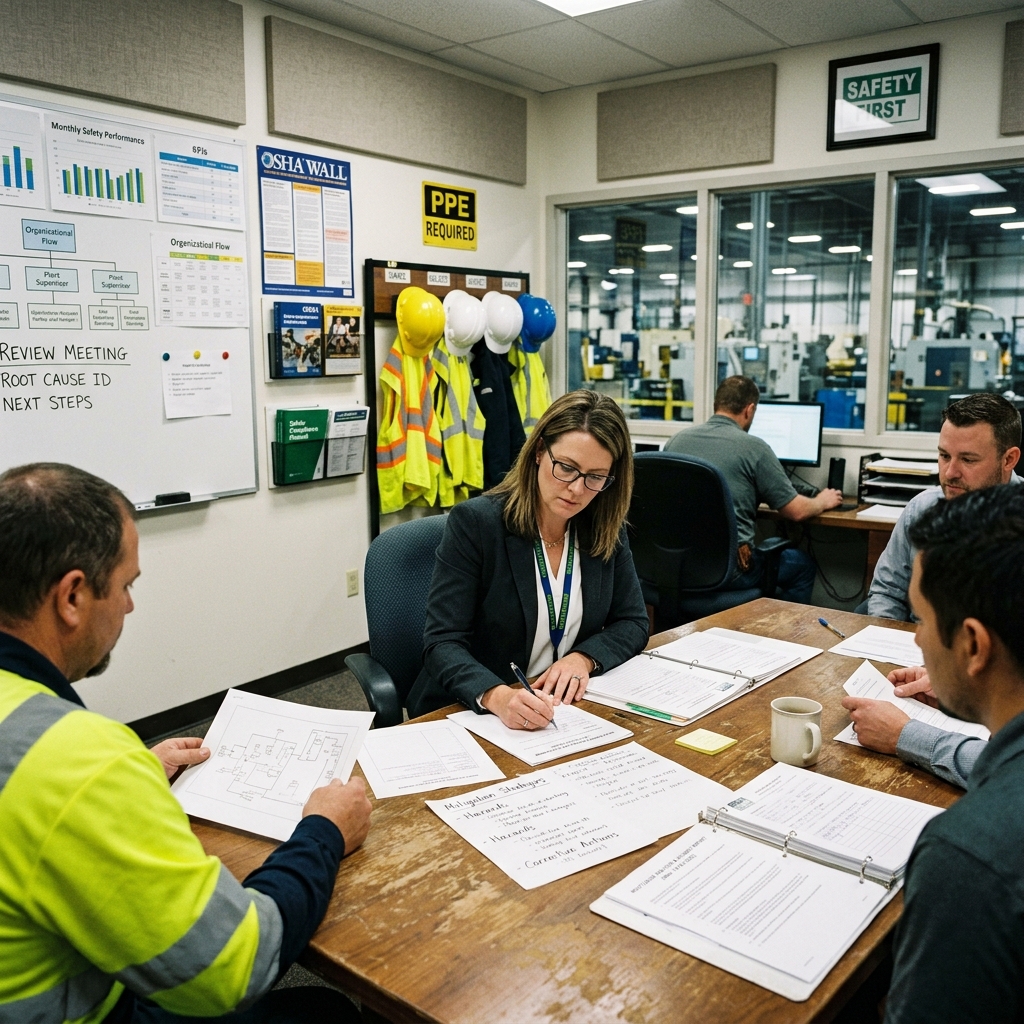
Accident Reporting Training: Why It Matters and How to Get It Right
Accident reporting training teaches employees at every level how to document, report, and escalate workplace incidents accurately and on time. Done well, it strengthens OSHA compliance, sharpens your incident data, and builds a culture where people report near misses before they become injuries. This guide covers what the training includes, who needs it, what formats work, and how to choose a program that actually moves the needle. A workplace incident that goes unreported isn't a smaller problem—it's a hidden one. And hidden hazards have a way of coming back, usually with a higher cost the second time around. That's the core reason accident reporting training deserves more attention than it typically gets. Investigation skills get the spotlight, but investigation only works when the incident gets reported in the first place—accurately, promptly, and with enough detail to act on. Reporting is where the entire safety data pipeline begins. If it's weak at the source, everything downstream suffers: your OSHA 300 log, your trend analysis, your corrective actions, and your audit readiness. This post breaks down what accident reporting training involves, why it matters for compliance and safety culture, who needs it, and how to choose a program that delivers real results for your team. SafetyKnights safety content: https://safetyknights.com/content
What Is Accident Reporting Training?
Accident reporting training equips employees with the knowledge and skills to identify, document, and report workplace incidents correctly. It covers the full reporting lifecycle—from recognizing that an event needs to be reported, to capturing the right details, to routing the report through the proper channels within required timeframes. It's easy to assume reporting is intuitive. It isn't. Employees regularly hesitate to report because they fear blame, don't know what qualifies as reportable, or aren't sure who to tell. Others report inconsistently—one person logs a near miss, another shrugs off the same event as "no big deal." Training removes that ambiguity. A strong program answers three questions for every employee: * **What** needs to be reported: injuries, illnesses, near misses, property damage, and unsafe conditions * **How** to report it: forms, systems, and the level of detail required * **When** to report it: immediately, within a shift, or within applicable regulatory deadlines When those answers are clear and consistent across your workforce, your reporting data becomes something you can actually trust and act on. SafetyKnights post-accident response policy and training: https://safetyknights.com/hustle/620696e38f9507001843ef53/post_accident_response_policy_trainingWhy Accident Reporting Training Is Essential
Accident reporting training affects more than paperwork. It influences regulatory compliance, the quality of your safety data, and whether employees feel comfortable raising concerns before someone gets hurt.It's the Foundation of OSHA Compliance
OSHA doesn't just require employers covered by its recordkeeping requirements to keep records—it establishes specific requirements and timelines for recording and reporting qualifying workplace injuries and illnesses. Employers must report a work-related fatality to OSHA within **8 hours** and a work-related inpatient hospitalization, amputation, or loss of an eye within **24 hours**. Recordable injuries and illnesses must be entered on the OSHA 300 Log and OSHA 301 Incident Report within **7 calendar days** of receiving information that a recordable injury or illness occurred. OSHA recordkeeping requirements: https://www.osha.gov/recordkeeping OSHA severe injury reporting: https://www.osha.gov/report Miss those windows or misclassify an incident, and you're exposed to potential compliance problems during an inspection. Training helps ensure the people closest to incidents understand these obligations rather than leaving compliance to chance.It Protects the Integrity of Your Safety Data
Your incident data drives everything: where you invest in controls, how you prioritize training, and how you demonstrate program performance to leadership. Inconsistent or incomplete reporting corrupts that data. If frontline workers underreport near misses, your leading indicators disappear, and you lose an important early-warning mechanism for identifying hazards. SafetyKnights near-miss discussion: https://safetyknights.com/hustle/632200831dc9020018d1961b/near_missIt Builds a Reporting Culture, Not a Blame Culture
Fear can become a major barrier to reporting. Workers who believe reporting an incident—or a near miss—will get them or a coworker in trouble may hesitate to speak up. Effective training reframes reporting as a shared safety tool, not a disciplinary trigger. That cultural shift can help organizations identify hazards earlier instead of reacting only after someone gets hurt.Who Needs Accident Reporting Training?
Reporting is everyone's responsibility, but different roles need different levels of training. * **Frontline workers** need to recognize what qualifies as a reportable event—including near misses and unsafe conditions—and know exactly how and when to report it. Their training should be practical and low-friction, focused on removing hesitation. * **Supervisors and team leads** are often the first point of contact for a report. They need training on receiving reports without judgment, gathering initial details, preserving the scene, and escalating appropriately. A supervisor who mishandles the first few minutes can compromise the follow-up investigation. * **Safety managers and coordinators** need the deepest competency: classification of recordable versus non-recordable incidents, OSHA 300/300A/301 recordkeeping, regulatory reporting timelines, and trend analysis. They often own the program and help train everyone else. * **HR and operations staff**, particularly in smaller organizations without a dedicated safety team, are frequently pulled into the reporting and recordkeeping process. They benefit from training that clarifies their role and the compliance stakes involved. The goal isn't identical training for everyone. It's role-appropriate training that ensures a report never falls through the cracks because someone didn't know it was their job to act.What a Good Accident Reporting Training Program Includes
Not all reporting training is created equal. The strongest programs go well beyond "fill out this form." Here's what to look for.Near-Miss Reporting
Near misses can provide valuable prevention data because they reveal events that could have caused harm but didn't. A quality program teaches workers to recognize and report near misses without fear and explains how those reports can help identify hazards before they contribute to an injury. SafetyKnights discussion on near-miss reporting quality: https://www.safetyknights.com/post/677f5a967935a100152d60ca/quality_over_quantity_the_problem_with_near_miss_quotasRecordable vs. Non-Recordable Incidents
Misclassification can create significant recordkeeping problems. Training should walk through OSHA's recordability criteria clearly, including work-relatedness, medical treatment beyond first aid, days away from work, restricted work, and other recording triggers. When your team understands the criteria, your OSHA 300 Log is more likely to remain accurate and defensible. OSHA general recording criteria: https://www.osha.gov/laws-regs/regulations/standardnumber/1904/1904.7OSHA 300 Log and Recordkeeping
Employees responsible for recordkeeping need hands-on instruction on the OSHA 300 Log, OSHA 301 Incident Report, and OSHA 300A Annual Summary. Training should also cover applicable posting, record maintenance, and retention requirements. OSHA Forms 300, 300A, and 301: https://www.osha.gov/recordkeeping/formsReporting Timelines
Training should reinforce the specific deadlines for employees who may be involved in handling serious workplace incidents: * **8 hours** for a work-related fatality * **24 hours** for a work-related inpatient hospitalization, amputation, or loss of an eye * **7 calendar days** to enter a recordable injury or illness on the OSHA 300 Log and OSHA 301 Incident Report after receiving information that the case is recordable OSHA reporting requirements: https://www.osha.gov/laws-regs/regulations/standardnumber/1904/1904.39Documentation Best Practices
Good documentation is specific, factual, and free of speculation or blame. Training should cover: * Who was involved * What happened * When the event occurred * Where it occurred * How it occurred * Objective observations * Relevant witness information * Photos or other supporting documentation when appropriate * Conditions present at the time of the incident Capturing clear information while it's fresh can make the follow-up investigation dramatically easier.Reporting Channels and Escalation
Employees need to know the exact path a report takes—who receives it, what happens next, and how serious events get escalated immediately rather than waiting in a queue. A reporting process only works when employees understand how to use it.Types of Accident Reporting Training Formats
The right delivery format depends on your workforce size, shift patterns, locations, job duties, and how frequently employees may need to report incidents.In-Person Training
Instructor-led sessions work well for hands-on practice, role-specific scenarios, and building buy-in through discussion. They're especially useful for supervisors and safety staff who benefit from working through real reporting decisions together. The tradeoff is scheduling. Coordinating multiple shifts, departments, and locations can be a challenge.Online and Self-Paced Training
Online modules can scale across large or distributed workforces and let employees complete training around their shifts. They're efficient for foundational, standardized content such as: * What to report * How to report * When to report * Where reports should go Look for programs with knowledge checks and scenario-based questions so the learning doesn't become a click-through exercise.Blended Learning
Blended programs combine online instruction with live practice, capturing the strengths of both formats. Employees can complete foundational content online and then apply it during facilitated sessions using real or simulated incidents. For many organizations, this provides a useful balance between scale and depth.How to Choose the Right Accident Reporting Training Program
Use these criteria to separate high-value programs from box-checking exercises: * **Does it teach classification accurately?** The program should cover OSHA recordability criteria in depth rather than glossing over them. * **Is it role-specific?** One-size-fits-all training can underserve both frontline workers and safety managers. Look for content tailored to different responsibilities. * **Does it emphasize near-miss reporting and reporting culture?** A program focused only on injury paperwork misses an important prevention opportunity. * **Does it include practical application?** Scenario exercises and real-world examples build capability. Passive content may document training completion without necessarily building competence. * **Is it current with regulations?** Confirm the content reflects current OSHA reporting and recordkeeping requirements. * **Who developed it?** Consider whether the program was built and delivered by safety professionals with relevant field and regulatory experience. The right program should help employees make better decisions when an actual incident occurs—not simply complete another required course.How Accident Reporting Training Connects to Safety Credentials
Accident reporting and recordkeeping aren't isolated skills. They're core competencies that safety professionals use throughout their careers and may encounter while preparing for professional safety certifications. The Associate Safety Professional (ASP) and Certified Safety Professional (CSP) credentials both require safety professionals to understand areas connected to incident management, regulatory compliance, and safety data. Completing formal reporting and recordkeeping training gives you practical grounding in concepts that can otherwise feel abstract in a textbook. If you've actually managed an OSHA 300 Log, classified borderline recordable cases, and navigated reporting deadlines under pressure, those concepts become far more approachable. Some accident reporting or recordkeeping courses may also qualify for professional development credit toward credential recertification. If credential maintenance matters to you, confirm eligibility with the training provider and the credentialing organization before enrolling, and retain your completion documentation. For safety professionals building toward advanced credentials, reporting training isn't just compliance work—it can also strengthen practical knowledge used throughout the profession.Turning Reporting Training Into Measurable Results
Training is the input. What you want are outcomes: more useful near-miss reports, faster reporting, cleaner classification, and a workforce that reports without hesitation. Track those indicators. An increase in near-miss or hazard reports after training isn't automatically a red flag. It may indicate that employees are becoming more comfortable surfacing risks that previously went unreported. Useful measures can include: * Number and quality of near-miss reports * Time between an incident and initial reporting * Number of late or incomplete reports * Recordkeeping classification accuracy * Repeat incidents involving previously identified hazards * Corrective actions generated from employee reports * Time required to close corrective actions Reinforce the training beyond the classroom. Recognize employees who report legitimate concerns. Close the loop by sharing what actions came from their reports. Keep the message consistent from supervisors to senior leadership. When people see that reporting leads to real change—not blame—they have a reason to keep participating. Accident reporting is the front door to your entire safety program. Get the training right, and everything behind that door works better: your investigations, your data, your compliance posture, and your ability to protect the people who count on you.FAQ
Here are answers to common questions about accident reporting training, OSHA recordkeeping, and building an effective workplace reporting process:What's the Difference Between Accident Reporting Training and Incident Investigation Training?
Accident reporting training focuses on recognizing, documenting, and reporting an incident accurately and on time. It's the front end of the process and can apply to employees throughout the organization. Incident investigation training focuses on what happens after a report comes in: evidence collection, causal analysis, and corrective action development, typically led by supervisors, safety professionals, or designated investigators. Reporting captures the event. Investigation works to understand why it happened. A strong safety program needs both. SafetyKnights post-accident response resources: https://safetyknights.com/hustle/620696e38f9507001843ef53/post_accident_response_policy_trainingHow Often Should Accident Reporting Training Be Conducted?
Provide reporting training during onboarding so employees understand the process before an incident occurs. Periodic refresher training can help reinforce expectations and address gaps. Additional training may be appropriate when regulatory requirements change, internal reporting systems or forms are updated, employee responsibilities change, or incident data suggests underreporting or inconsistent classification.Does Accident Reporting Training Help With OSHA Compliance?
Yes. Effective training helps the employees responsible for reporting and recordkeeping understand what information must be captured, how cases are evaluated, and when qualifying incidents must be reported or recorded. OSHA recordkeeping information: https://www.osha.gov/recordkeeping OSHA severe incident reporting: https://www.osha.gov/reportDo Frontline Workers Really Need Reporting Training, or Just Supervisors?
Frontline workers need reporting training because they're often the first people to witness or experience workplace incidents, unsafe conditions, and near misses. Without clear training, employees may not recognize what should be reported or may hesitate because they don't understand the process. Their training should be practical and focused on removing barriers, while supervisors and safety staff receive more advanced instruction on receiving, classifying, documenting, and escalating reports.Can Accident Reporting Training Count Toward ASP or CSP Recertification?
Some reporting and recordkeeping courses may qualify for professional development or recertification credit, but eligibility depends on the specific course, provider, credential, and current recertification requirements. Confirm eligibility before enrolling and retain your training completion documentation.How Do You Measure Whether Reporting Training Is Working?
Start with your leading indicators. Look at near-miss and hazard reporting, reporting timeliness, completeness of incident documentation, and classification accuracy. Then look downstream. Better reporting should help produce cleaner safety data, stronger corrective actions, better hazard identification, and fewer repeat incidents. The goal isn't simply to generate more reports. It's to generate better information earlier so your organization can act before the next incident occurs.Additional Resources
Use these resources to learn more about accident reporting, OSHA recordkeeping, near misses, and incident response: * SafetyKnights safety content: https://safetyknights.com/content * SafetyKnights post-accident response policy and training: https://safetyknights.com/hustle/620696e38f9507001843ef53/post_accident_response_policy_training * SafetyKnights near-miss discussion: https://safetyknights.com/hustle/632200831dc9020018d1961b/near_miss * OSHA recordkeeping requirements: https://www.osha.gov/recordkeeping * OSHA Forms 300, 300A, and 301: https://www.osha.gov/recordkeeping/forms * OSHA severe injury and fatality reporting: https://www.osha.gov/report * OSHA reporting standard, 29 CFR 1904.39: https://www.osha.gov/laws-regs/regulations/standardnumber/1904/1904.39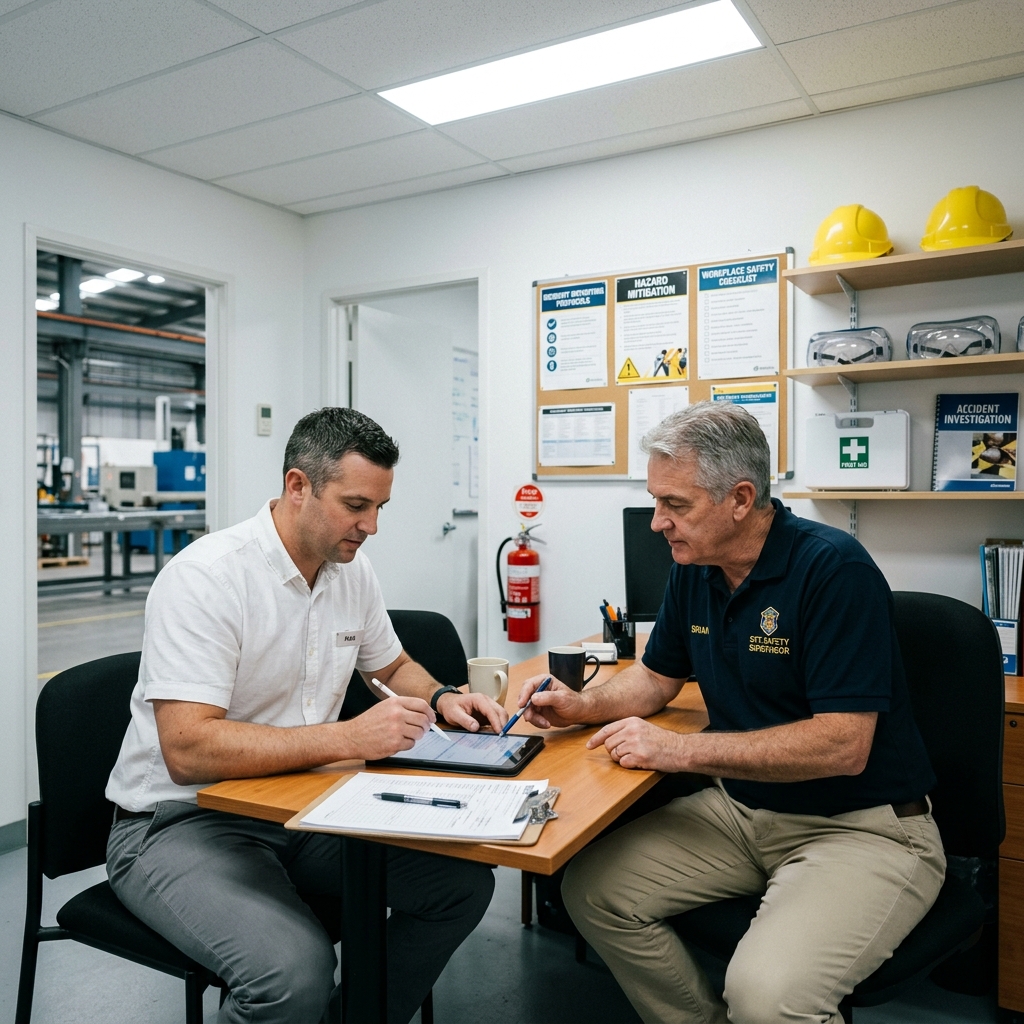
Safety Summits That Actually Move the Needle on Workplace Safety
Safety summits bring together safety professionals, industry leaders, and regulators to share knowledge, address emerging hazards, and strengthen workplace safety culture. From community-driven events like the People’s Safety Summit to major national conferences, these gatherings offer practical tools, peer learning, and insights that safety teams can apply immediately. Every safety professional knows the frustration: regulations shift, incident rates plateau, and the day-to-day demands of managing a safety program leave little room for strategic thinking. Safety summits exist to break that cycle. They compress months of professional development into focused, high-impact events where real practitioners share what’s working on the ground. This post covers what safety summits are, why they matter for safety professionals across industries, and which events deserve a spot on your calendar—including a closer look at the **People’s Safety Summit**, a community-driven gathering built around practical learning, honest conversations, and the people doing safety work every day.
What Is a Safety Summit—and Why Should Safety Professionals Attend?
A safety summit is a structured professional event designed to advance workplace safety through education, networking, and the exchange of proven strategies. Unlike general industry conferences, safety summits tend to focus specifically on hazard mitigation, regulatory compliance, leadership, and safety culture. Attendance matters because safety professionals often work in silos. A summit breaks that isolation. You gain direct access to peers who’ve navigated the same regulatory pressures, managed similar incident investigations, and built safety cultures from the ground up. That peer-to-peer knowledge transfer is something no training manual can replicate. SafetyKnights content hub: https://www.safetyknights.com/content The return on investment goes beyond the sessions themselves. Some of the most useful ideas can come from conversations with other safety professionals, informal discussions after sessions, and the opportunity to compare what is actually working across different workplaces.How Do Safety Summits Differ From Standard Safety Training?
Standard safety training focuses on compliance fundamentals: OSHA requirements, hazard identification procedures, incident reporting protocols, and other essential responsibilities. That training is important, but safety summits operate differently. They create space for emerging ideas, real-world case studies, and conversations about challenges that may not fit neatly inside a traditional training program. Topics can include: * Psychological safety * Safety technology adoption * Leadership and worker engagement * Communication strategies * Near-miss reporting * Mental health and burnout * Safety culture * Emerging workplace hazards The distinction matters for safety professionals who carry decision-making responsibility within their organizations. Summits can help you think beyond minimum compliance and identify ways to strengthen the overall safety program. SafetyKnights podcast library: https://www.safetyknights.com/podcastsSafety Summits Worth Knowing About
Different safety events serve different audiences. Some focus heavily on professional development and regulatory education, while others emphasize community, practical conversations, and peer learning.The People’s Safety Summit
The **People’s Safety Summit** brings safety professionals together for community-driven conversations, practical education, and real-world knowledge sharing. Rather than focusing only on presentations and compliance updates, the People’s Safety Summit creates space for safety professionals to discuss the challenges they are actually facing, learn from others in the field, and build meaningful connections across the safety community. People’s Safety Summit: https://safetyknights.com/peoples_summit The event is designed for safety professionals across experience levels, from newer practitioners to experienced EHS leaders. Topics focus on issues shaping workplace safety today, including: * Safety culture * Leadership * Communication * Worker engagement * Heat stress prevention * Psychological safety * Mental health and burnout * Emerging workplace hazards * Practical strategies safety professionals can apply on the job SafetyKnights community and mission: https://www.safetyknights.com/missionNational Safety Council Congress & Expo
The NSC Congress & Expo is one of the largest occupational safety events in the United States. It covers a broad range of workplace safety topics, from fall protection and risk management to workplace health and safety technology. Key strengths of this summit include: * Broad industry representation across manufacturing, construction, healthcare, and other sectors * Access to safety technology, equipment, and service providers * Educational sessions covering technical and leadership topics * Professional development opportunities for safety practitioners National Safety Council workplace safety: https://www.nsc.org/work-safetyASSP Safety Conference
The American Society of Safety Professionals hosts a major annual professional development conference for occupational safety and health practitioners. The event can be particularly valuable for professionals interested in technical education, leadership development, professional credentials, and networking with other safety practitioners.Sector-Specific and Regional Safety Summits
Regional and sector-specific summits fill an important gap. Construction safety summits, healthcare safety forums, manufacturing events, and other specialized conferences can bring highly relevant content to professionals dealing with industry-specific hazards and regulatory environments. These events are often smaller, which can mean more direct engagement with speakers and more opportunities for peer-to-peer learning.IOSH Conference (International)
For safety professionals with international responsibilities, IOSH events provide opportunities to explore occupational safety and health from a broader global perspective. These events can be especially relevant to professionals interested in international safety practices, leadership, research, and occupational health and safety policy.What Sets the People’s Safety Summit Apart?
The **People’s Safety Summit** represents a different approach to professional safety gatherings. Rather than making safety professionals passive members of an audience, the People’s Safety Summit puts the community and its experiences at the center of the conversation. The goal is practical: bring safety professionals together to talk about the challenges they are actually facing, share lessons from the field, and create conversations that continue after the event ends. People’s Safety Summit: https://safetyknights.com/peoples_summitCommunity Comes First
The People’s Safety Summit is built around the idea that some of the most valuable safety knowledge comes from the people doing the work. That means creating room for: * Honest conversations about what is and is not working * Lessons learned from real workplace experiences * Practical strategies safety professionals can take back to their organizations * Discussions about leadership, culture, and communication * Connections between safety professionals at different stages of their careers * Community-driven learning instead of one-way presentations The emphasis is not simply on hearing another presentation. It is about helping safety professionals connect, learn from one another, and leave with ideas they can actually use.Who Attends the People’s Safety Summit?
The People’s Safety Summit is for people across the safety profession. Attendees can include: * Safety coordinators * Safety managers * EHS professionals * Frontline safety leaders * Consultants * Trainers * New safety professionals * Experienced safety leaders * Anyone working to improve workplace safety A newer safety professional may be trying to figure out how to gain leadership support for a program. A veteran safety leader may be looking for new ways to improve worker engagement. Putting those professionals in the same conversation creates opportunities for both to learn. SafetyKnights community: https://www.safetyknights.com/join-usWhat Topics Does the People’s Safety Summit Cover?
The People’s Safety Summit focuses on the challenges safety professionals are dealing with in the real world. Topics may include: * Psychological safety and reporting culture * Heat stress prevention * Communication that changes behavior * Leadership buy-in * Building safety programs with limited resources * Lessons from incidents and near misses * Mental health and burnout among safety professionals * Safety culture * Worker engagement * Practical approaches to emerging safety challenges These conversations recognize that regulations remain an essential foundation of workplace safety, but sustainable improvement also depends on communication, leadership, trust, and culture.Why Community Matters in Workplace Safety
Safety professionals are often expected to have the answer. You may be responsible for compliance, investigations, training, reporting, leadership communication, worker engagement, and emergency response—all while managing the everyday realities of the workplace. That responsibility can become isolating. Events like the People’s Safety Summit create a space where safety professionals can compare experiences, ask difficult questions, and learn from people who understand the challenges firsthand. A strong professional community does more than exchange information. It gives safety professionals access to perspectives they may never encounter inside their own organization.How to Choose the Right Safety Summit for Your Professional Goals
The value you get from a safety summit depends heavily on how closely the event matches the challenges you are currently trying to solve. Consider a few questions before choosing an event: * **What problems am I trying to solve?** Look for sessions and speakers that connect directly to your current workplace challenges. * **Do I want technical education or broader conversations?** Some conferences emphasize technical and regulatory instruction, while community-focused events like the People’s Safety Summit create more room for practical discussion and peer learning. * **Am I looking for credentials or connections?** Professional associations can be especially valuable for continuing education, while community-driven events can be particularly strong for networking and knowledge sharing. * **What can I realistically attend?** Consider registration costs, travel, time away from work, and virtual attendance options. SafetyKnights announcements and events: https://www.safetyknights.com/announcementMaking the Most of Any Safety Summit You Attend
Showing up is only the beginning. Safety professionals who get the most value from summits approach them as active learning opportunities. Before the event, identify two or three specific problems you want help solving. Review the sessions and prioritize the conversations most relevant to those challenges. During the summit, capture more than notes. Write down: * Ideas you want to test * Resources you want to investigate * People you want to follow up with * Questions you want to bring back to your team * Changes you may want to make in your safety program After the event, turn those ideas into action. Share the most important takeaways with your team. Follow up with the people you met. Choose one or two ideas you can realistically test instead of allowing a notebook full of good information to sit untouched. SafetyKnights resources: https://www.safetyknights.com/hustle Safety summits can provide some of the most valuable professional development available to safety practitioners, but the value comes from more than presentations. It comes from conversations, shared experiences, new perspectives, and the opportunity to connect with people who understand the realities of protecting workers. That is exactly what the **People’s Safety Summit** is built to create. People’s Safety Summit: https://safetyknights.com/peoples_summitFAQ
Here are answers to common questions about safety summits and the People’s Safety Summit:What is the primary purpose of a safety summit?
A safety summit brings professionals together to learn, exchange practical strategies, discuss workplace safety challenges, and build connections with others in the field. Depending on the event, the focus may include regulatory education, technical training, leadership, safety culture, emerging hazards, or peer-to-peer learning.What is the People’s Safety Summit?
The People’s Safety Summit is a community-driven safety event focused on practical conversations, professional connection, and knowledge sharing among people working in workplace safety. Its emphasis is on the experiences of safety professionals themselves and the lessons they can share with one another. People’s Safety Summit: https://safetyknights.com/peoples_summitWho should attend the People’s Safety Summit?
The People’s Safety Summit is relevant to safety professionals across experience levels, from people entering the profession to experienced safety leaders. It is particularly useful for professionals interested in practical ideas, community, collaboration, and conversations about the real challenges they face at work.Is the People’s Safety Summit only for experienced safety professionals?
No. One of the strengths of a community-driven event is bringing professionals with different levels of experience into the same conversation. Newer professionals can learn from experienced practitioners, while veteran safety leaders can gain fresh perspectives from people entering the profession.How can safety summits help improve workplace safety?
Safety summits expose professionals to new strategies, lessons learned, emerging ideas, and perspectives from outside their own organizations. The real impact happens when attendees bring those lessons home and translate them into better conversations, stronger programs, and practical workplace improvements.How can I learn more about the People’s Safety Summit?
Visit the People’s Safety Summit page for event information and updates. People’s Safety Summit: https://safetyknights.com/peoples_summit SafetyKnights home: https://www.safetyknights.com/ SafetyKnights mission: https://www.safetyknights.com/mission SafetyKnights community: https://www.safetyknights.com/join-us SafetyKnights announcements and events: https://www.safetyknights.com/announcement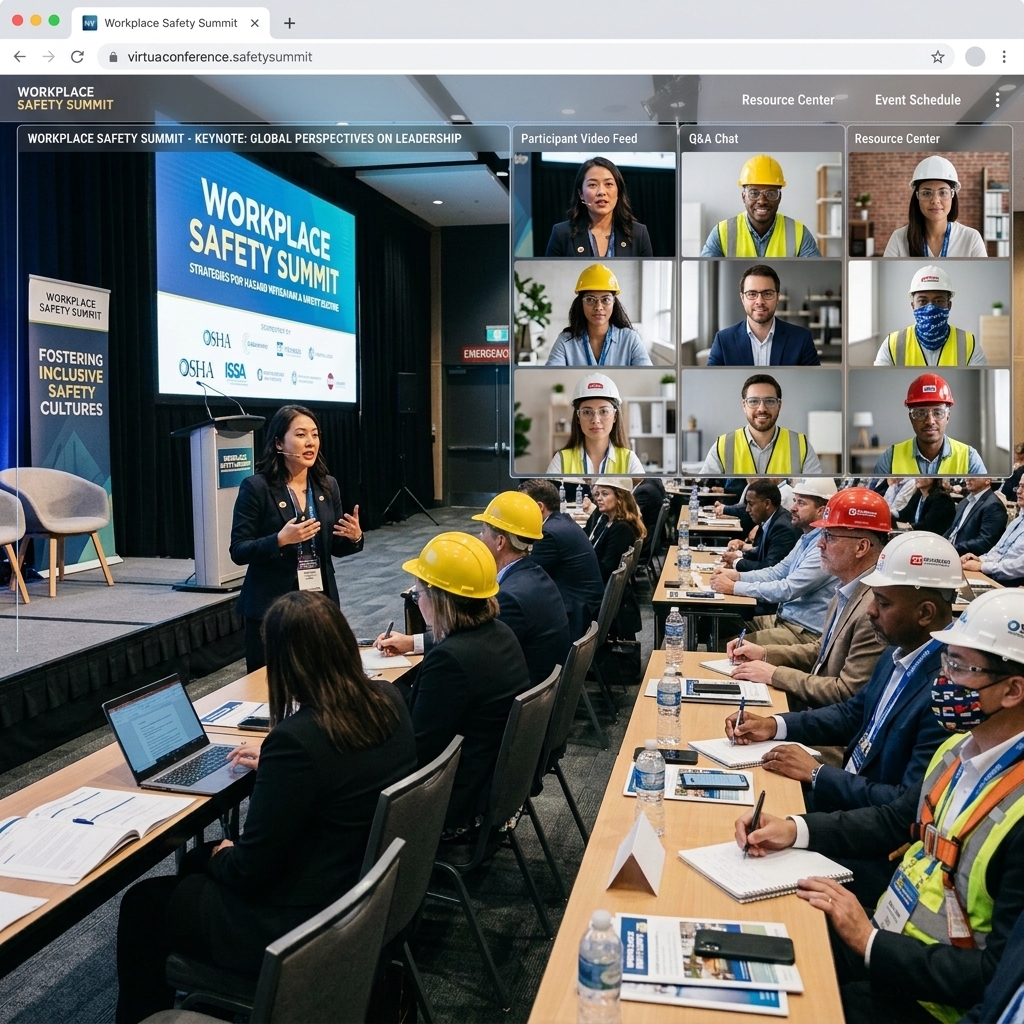

Safety Knights and Headcount Partner to Help Organizations Improve Emergency Accountability and Evacuation Response
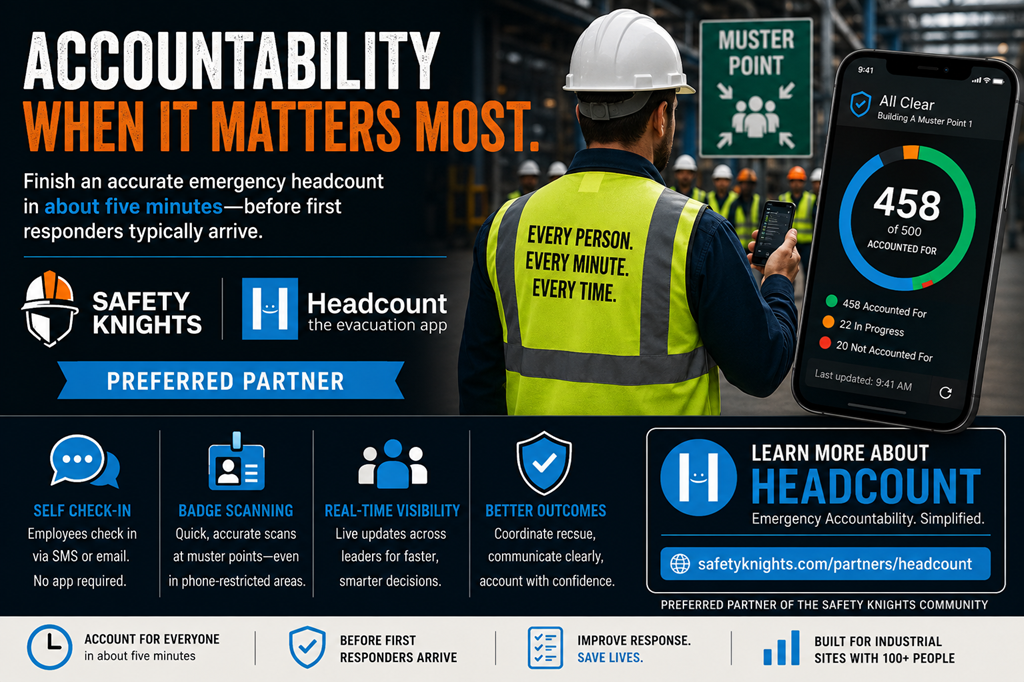
New partnership connects safety professionals with an emergency accountability platform designed to help organizations account for employees, contractors, and visitors in about five minutes - before first responders typically arrive. [ROCHESTER, NY — AUGUST 09, 2026] — Safety Knights, a growing community dedicated to connecting safety professionals with practical, real-world solutions, today announced a partnership with Headcount, an emergency accountability platform built specifically for industrial workplaces. Through the partnership, Headcount joins the Safety Knights Preferred Partner Program, giving members direct access to a modern emergency headcount solution that helps organizations improve evacuation accountability, strengthen emergency preparedness, and make faster, more informed decisions during critical incidents. When an emergency occurs, the first few minutes are often the most important. Whether responding to a fire alarm, chemical release, severe weather event, active threat, or facility evacuation, safety leaders need to answer one critical question as quickly as possible: "Is everyone accounted for?" Unfortunately, many organizations still rely on paper rosters, radios, clipboards, and manual roll calls to answer that question. While these methods may work during routine drills, they often become slow, fragmented, and difficult to manage during a real emergency—especially across large industrial sites with multiple buildings, contractors, visitors, or hundreds of employees spread throughout a facility. Headcount helps solve this challenge by replacing manual accountability with a modern, technology-driven emergency headcount process. The platform enables employees to self-check in through SMS or email—without requiring an app for the general workforce—while badge scanning at muster points and real-time status updates provide incident commanders with immediate visibility into who is safe, who still needs to be located, and where additional resources should be focused. Rather than simply sending emergency notifications, Headcount helps organizations complete the accountability process quickly and confidently, allowing emergency teams to coordinate rescue efforts, communicate with first responders, and make critical decisions based on real-time information instead of uncertainty. For industrial facilities with large workforces, every minute matters. Organizations with hundreds of employees often spend valuable time manually verifying attendance after an evacuation. By accelerating accountability and reducing confusion during emergencies, Headcount helps safety teams improve emergency response while strengthening confidence in evacuation procedures and emergency drills. The platform is particularly well suited for manufacturing, industrial, energy, utility, and other high-risk operations where quickly accounting for employees, contractors, and visitors can have a significant impact on emergency outcomes. By combining Safety Knights' engaged community of safety professionals with Headcount's innovative emergency accountability technology, this partnership aims to help organizations modernize emergency preparedness, improve evacuation accountability, and give safety leaders greater confidence during the moments that matter most. Learn More About Headcount Explore how Headcount can help your organization improve emergency accountability, reduce manual roll calls, and complete an accurate emergency headcount in approximately five minutes. Schedule a complimentary assessment to review your current muster process and determine whether Headcount is a fit for your facility. 👉 https://safetyknights.com/partners/headcount
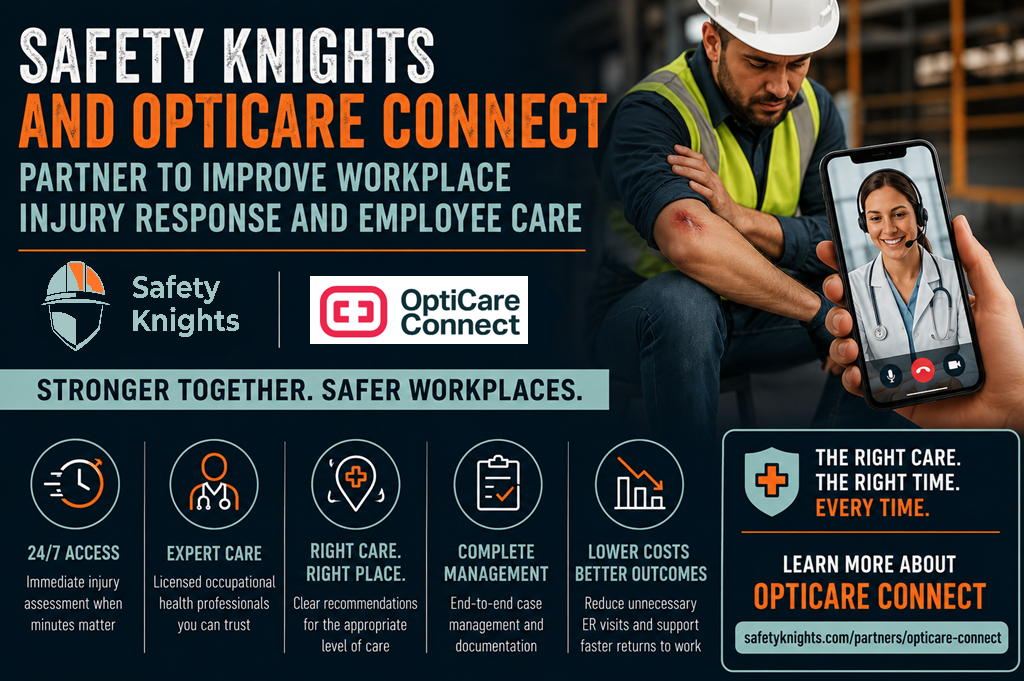
Safety Knights and OptiCare Connect Partner to Help Organizations Improve Workplace Injury Response and Occupational Health Management
New partnership connects safety professionals with a modern occupational health solution designed to deliver immediate injury assessment, reduce unnecessary medical costs, and help employees receive the right care - faster. [ROCHESTER, NY — JULY 19, 2026] — Safety Knights, a growing community focused on connecting safety professionals with practical, real-world solutions, today announced a partnership with OptiCare Connect, a leader in virtual occupational health and workplace injury management. Through the partnership, OptiCare Connect joins the Safety Knights Preferred Partner Page, giving members direct access to learn how a modern, technology-driven approach to injury management can improve employee care while reducing operational disruption. When a workplace injury occurs, the first few minutes matter. Too often, supervisors are forced to make difficult medical decisions without clinical expertise. A relatively minor injury may result in an unnecessary emergency room visit, while delayed treatment can create additional risk for both the employee and employer. Inconsistent care decisions can also increase workers' compensation costs, lost productivity, and administrative burden. OptiCare Connect helps solve this challenge by providing 24/7 access to licensed occupational health professionals through virtual telehealth, allowing injured employees to be evaluated within minutes. Their team provides immediate injury assessment, treatment recommendations, first-aid guidance, and determines the appropriate level of care—whether that's returning to work, visiting an occupational health clinic, or seeking emergency treatment. Beyond the initial assessment, OptiCare Connect manages the entire injury lifecycle through comprehensive case management, clinic coordination, OSHA-compliant documentation, and return-to-work support. Their nationwide network and dedicated occupational health specialists help organizations standardize injury management across multiple locations while reducing unnecessary emergency room visits and improving employee outcomes. For today's safety professionals, injury management is about more than simply responding after an incident. It's about ensuring employees receive the right care, at the right time, in the right setting while keeping communication clear, documentation complete, and recovery on track. By combining Safety Knights' engaged community of safety professionals with OptiCare Connect's expertise in virtual occupational health and injury management, this partnership aims to help organizations strengthen their injury response process, improve workforce care, and reduce the overall cost and complexity of workplace injuries. Learn More About OptiCare Connect Explore OptiCare Connect and learn how their occupational health and injury management platform can help your organization improve injury response, reduce unnecessary medical costs, and support better outcomes for your workforce: https://safetyknights.com/partners/opticare-connect
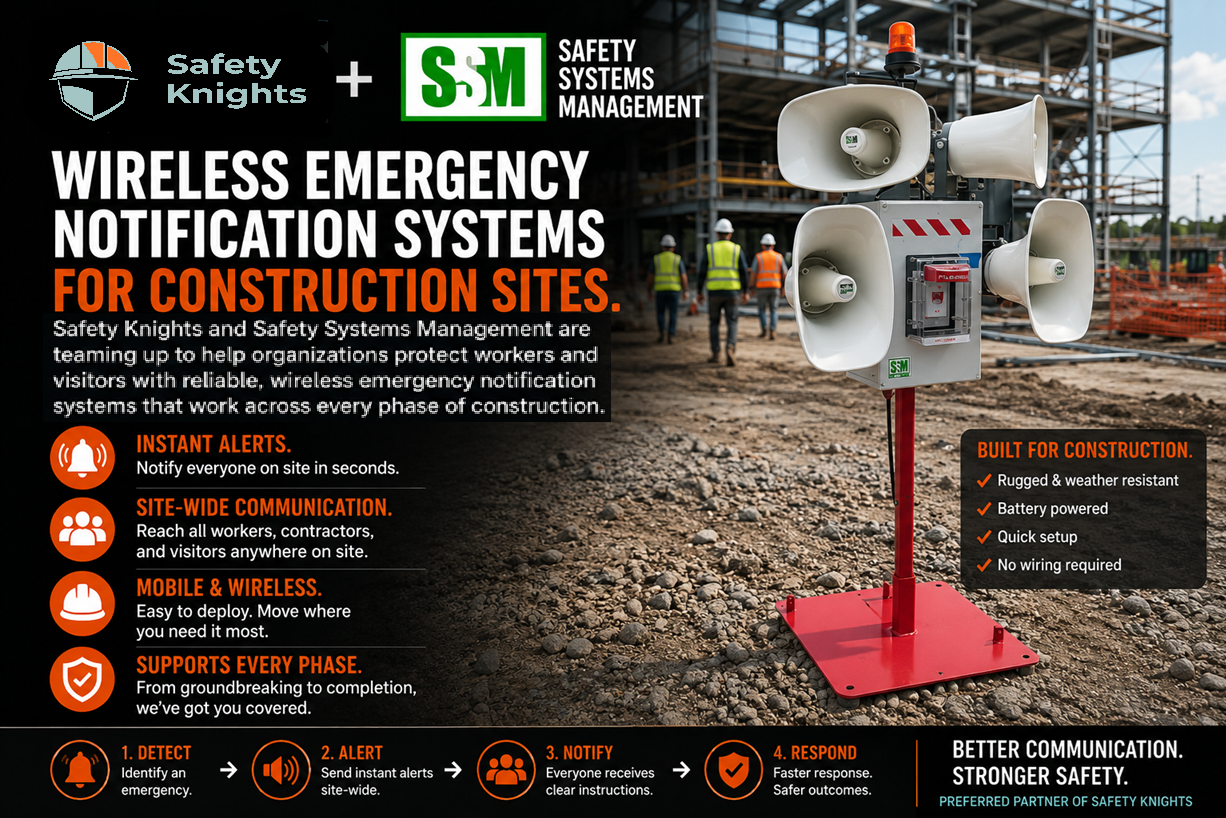
Safety Knights and Safety Systems Management Partner to Help Organizations Strengthen Emergency Communication and Site Safety
New partnership connects safety professionals with proven emergency communication systems designed to improve emergency response, protect workers, and reduce operational risk. [ROCHESTER, NY — JULY 11, 2026] — Safety Knights, a growing community focused on connecting safety professionals with practical, real-world solutions, today announced a partnership with Safety Systems Management (SSM), a provider of emergency communication and site safety systems that help organizations improve emergency preparedness across industrial, commercial, and construction environments. Through the partnership, Safety Systems Management joins the Safety Knights Preferred Partner Page, giving members direct access to learn how integrated emergency notification systems can strengthen workplace safety and operational resilience. When an emergency occurs, seconds matter. Whether it's a fire, chemical release, severe weather event, evacuation, confined space emergency, or other critical incident, organizations need reliable systems that immediately communicate with everyone on site. Traditional communication methods often rely on word of mouth, phone trees, or inconsistent notification processes that can create confusion during high-stress situations. Safety Systems Management helps solve this challenge by designing and implementing integrated emergency communication systems that provide clear, immediate notification when every second counts. Their solutions help organizations rapidly alert personnel, coordinate emergency response efforts, and improve situational awareness across facilities and job sites. From manufacturing plants and construction projects to industrial facilities and critical infrastructure, effective emergency communication is a foundational component of any comprehensive safety management program. By ensuring workers receive timely, consistent instructions during emergencies, organizations can reduce confusion, improve response times, and better protect both employees and visitors. By combining Safety Knights' engaged community of safety professionals with Safety Systems Management's expertise in emergency communication technology, this partnership aims to help organizations build stronger emergency preparedness programs while improving overall workplace safety. Learn More About Safety Systems Management Explore Safety Systems Management and learn how their emergency communication solutions can help your organization improve emergency response and site safety: https://safetyknights.com/partners/safety-systems-management
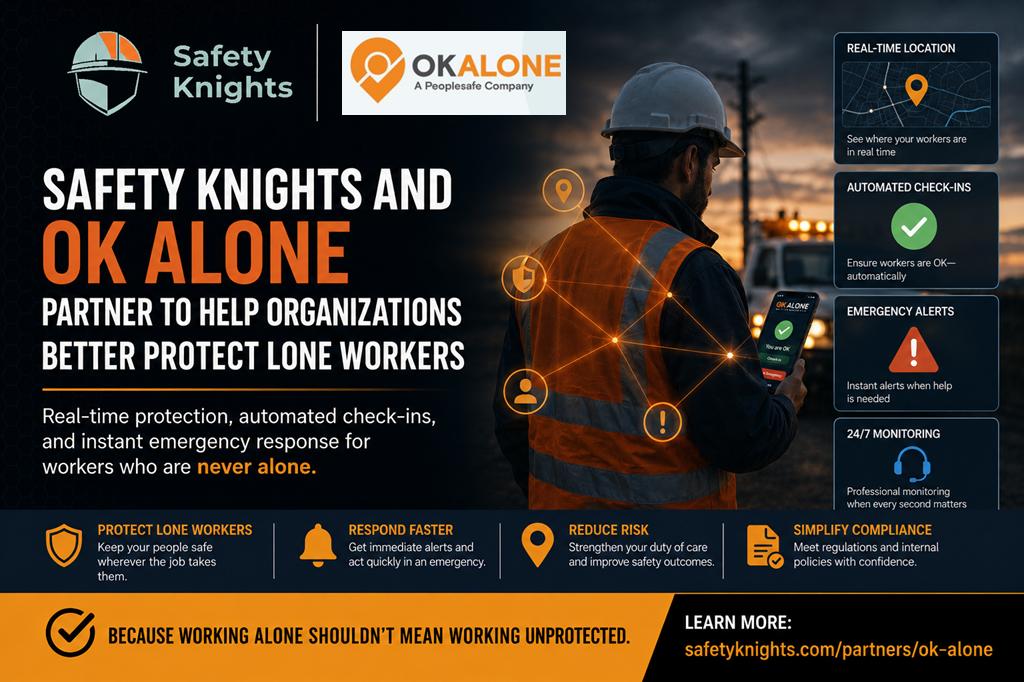
Safety Knights and OK Alone Partner to Help Organizations Better Protect Lone Workers
New partnership connects safety professionals with a leading lone worker solution designed to improve employee protection, emergency response, and peace of mind for workers in the field. [ROCHESTER, NY — JULY 5, 2026] — Safety Knights, a growing community focused on connecting safety professionals with practical, real-world solutions, today announced a partnership with OK Alone, a leading lone worker safety platform that helps organizations protect employees working independently through real-time monitoring, automated check-ins, GPS location services, and emergency response capabilities. Through the partnership, OK Alone joins the Safety Knights Preferred Partner Page, giving members direct access to learn how modern lone worker technology can strengthen safety programs while helping organizations meet their duty of care responsibilities. Whether it's utility crews, field service technicians, environmental consultants, healthcare workers, inspectors, sales representatives, maintenance personnel, or employees working after hours, millions of workers perform their jobs without immediate access to coworkers or supervisors. When emergencies occur, delayed response times can quickly turn routine incidents into life-threatening situations. OK Alone addresses these challenges by providing organizations with a comprehensive lone worker safety solution that combines automated check-ins, real-time GPS location tracking, panic alerts, man-down detection, and optional 24/7 monitoring services. The platform enables employers to quickly identify when a worker needs assistance and initiate emergency response when every second matters. Rather than relying on manual call-ins or outdated buddy systems, OK Alone gives organizations greater visibility into worker safety while reducing administrative burden and improving compliance with lone worker policies. The platform is designed to integrate seamlessly into everyday work, making it easier for employees to stay protected without disrupting productivity. Through the Safety Knights partnership, OK Alone will gain visibility across the Safety Knights community while engaging directly with safety leaders looking to modernize how they protect employees working alone or in remote environments. "Working alone shouldn't mean working unprotected," said Branden Raczkowski, Director of Safety Knights. "Many organizations have excellent safety programs inside their facilities, but field employees often face a completely different set of risks. OK Alone gives safety leaders confidence that their people are never truly alone, even when they're miles away from the nearest coworker. We're excited to bring this solution to the Safety Knights community." By combining Safety Knights' engaged network of safety professionals with OK Alone's proven lone worker technology, the partnership aims to help organizations improve emergency preparedness, strengthen worker protection, and ensure every employee has access to help when they need it most. Learn More About OK Alone https://safetyknights.com/partners/ok-alone
Construction Health and Safety Technician (CHST): Your Career Guide
The Construction Health and Safety Technician (CHST) certification is one of the most respected credentials a safety professional can earn in the construction industry. If you spend your days managing hazards on job sites, coordinating safety training, or keeping crews compliant with OSHA standards, the CHST can validate your expertise and open new doors. This guide breaks down what the CHST is, who it's for, how to qualify, and what it takes to pass the exam. You'll also learn how the certification can boost your earning potential and strengthen your standing as a safety leader. Construction remains one of the most hazardous industries in the United States. According to the Bureau of Labor Statistics, construction accounted for roughly one in five worker fatalities in private industry in recent years. That reality makes skilled safety technicians essential—and the CHST is a clear way to prove you have the knowledge to protect lives. Bureau of Labor Statistics injury data: https://www.bls.gov/iif/ Whether you're early in your safety career or ready to formalize years of field experience, this guide will help you decide if the CHST is the right move.
What is the Construction Health and Safety Technician (CHST) certification?
The CHST is a professional certification administered by the Board of Certified Safety Professionals (BCSP). It recognizes individuals who perform safety and health duties on construction sites, including hazard identification, incident prevention, and regulatory compliance. Unlike broad safety credentials, the CHST focuses specifically on construction environments. It signals that you understand the unique risks of job sites—falls, electrical hazards, excavation dangers, and heavy equipment operations among them. The certification is recognized across the industry by employers, general contractors, and government agencies. Holding it tells hiring managers that you've met a rigorous standard set by an accredited body. Board of Certified Safety Professionals: https://www.bcsp.orgWho should pursue the CHST certification?
The CHST is designed for professionals whose work involves construction safety, whether full-time or as part of a broader role. It suits people who want to demonstrate measurable competence rather than just years on the job. Good candidates often include: - Safety coordinators and safety managers working on construction projects - Site superintendents who oversee crew safety - Foremen and supervisors responsible for hazard control - Risk managers and insurance professionals serving construction clients - Military veterans transitioning into civilian safety careers If you're building a long-term career in safety, certifications like the CHST help you stand out in a competitive field. The safety profession also values shared knowledge, and earning credentials connects you with a community of people committed to protecting workers. Safety Knights community: https://safetyknights.com/join-usWhat are the CHST eligibility requirements?
Before you can sit for the CHST exam, you need to meet specific education and experience requirements set by BCSP. These standards ensure that candidates already have a practical foundation in construction safety. The core requirements generally include: - A minimum of a high school diploma or equivalent - At least three years of construction safety experience where safety duties make up a substantial portion of your role - Verification that your experience meets BCSP's definition of qualifying safety work BCSP evaluates each application to confirm that your experience is relevant and current. Because requirements can change, always confirm the latest criteria directly with the certifying body before applying. Official CHST requirements: https://www.bcsp.org/CHSTHow do you apply for the CHST exam?
The application process is straightforward but requires documentation. You'll need to create a BCSP account, submit proof of your experience, and pay the application fee. Here's the typical path: - Create an account on the BCSP website - Complete the CHST application and document your qualifying experience - Pay the required application and examination fees - Wait for approval, which confirms your eligibility to schedule the exam - Schedule your exam at an approved testing center or through remote proctoring Once approved, you'll receive an authorization to test. From there, you can book a date that gives you enough time to prepare thoroughly. Safety Knights articles: https://safetyknights.com/content/articlesWhat topics does the CHST exam cover?
The CHST exam tests your knowledge across the full range of construction safety responsibilities. It's built around the real tasks a safety technician performs on the job. Major content areas include: - Program management and safety administration - Worksite auditing and hazard recognition - Training and education of workers - Professional responsibility and ethics - Risk identification, assessment, and control The exam draws heavily on OSHA construction standards, particularly 29 CFR 1926. Understanding these regulations cold is essential, since much of the test centers on applying them to real-world situations. OSHA construction standards: https://www.osha.gov/constructionHow should you prepare for the CHST exam?
Preparation makes the difference between passing on your first attempt and repeating the process. The exam is challenging, and most successful candidates follow a structured study plan over several weeks or months. These strategies help candidates pass: - Review the official BCSP exam blueprint to understand topic weighting - Study OSHA 29 CFR 1926 standards in depth - Use practice exams to identify weak areas and build test-taking stamina - Join study groups or online forums where candidates share resources - Set a realistic timeline and study consistently rather than cramming Real-world experience is your biggest asset here. Connecting classroom knowledge to situations you've actually encountered on site will help you reason through tricky exam questions. Safety Knights content: https://safetyknights.com/contentWhy is the CHST worth earning for your safety career?
The CHST does more than add letters after your name. It can directly affect your job prospects, credibility, and pay. Certified professionals often see tangible benefits: - Stronger job applications and a competitive edge in hiring - Higher earning potential compared to non-certified peers - Greater credibility with employers, clients, and regulators - Access to advanced roles in safety management and leadership - A foundation for pursuing higher-level certifications later For employers, hiring CHST-certified technicians supports a proactive safety culture and helps mitigate risk before incidents occur. That value is exactly why the credential carries weight across the construction industry. Safety Knights podcasts: https://safetyknights.com/podcastsHow does the CHST compare to other safety certifications?
The CHST isn't the only safety credential available, and choosing the right one depends on your career goals. Each certification serves a different purpose and audience. Here's how to think about it: - Choose the CHST if your work focuses specifically on construction safety - Consider the Associate Safety Professional (ASP) if you're building toward the Certified Safety Professional (CSP) across multiple industries - Look at the OHST (Occupational Health and Safety Technician) if your work spans general industry rather than construction alone Many professionals stack credentials over time. Starting with the CHST can be a smart move if construction is your focus, and it can complement broader certifications down the road. BCSP certification options: https://www.bcsp.org/credentials-at-a-glance Earning the CHST is a meaningful step toward becoming a recognized leader in construction safety. With the right preparation, qualifying experience, and a commitment to protecting workers, you can pass the exam and use the credential to advance your career while making job sites safer for everyone around you.FAQ
Below are answers to some of the most common questions safety professionals ask about the Construction Health and Safety Technician certification.How much does the CHST certification cost?
Costs include an application fee and an examination fee, along with ongoing renewal fees to maintain the credential. Exact amounts vary, so check the BCSP website for current pricing before applying.How long does it take to get CHST certified?
The timeline depends on how quickly your application is approved and how long you study. Many candidates spend two to four months preparing before sitting for the exam, on top of the three years of required experience.Do I need a college degree to earn the CHST?
No. A high school diploma or equivalent meets the education requirement. The certification places greater emphasis on qualifying construction safety experience than on formal degrees.How do I maintain my CHST after passing the exam?
The CHST requires recertification through BCSP's program, which involves continuing education and professional development activities. Staying active in the field and pursuing ongoing training makes recertification easier.Is the CHST recognized nationally?
Yes. Because BCSP is an accredited certifying body, the CHST is recognized across the United States by employers, contractors, and government agencies in the construction industry.Taking the Next Step Toward CHST
The CHST puts you on a clear path to greater credibility, stronger pay, and bigger opportunities in construction safety. Map out your eligibility, build a focused study plan, and lean on the community of safety pros who have already walked this road. Your future on the job site—and the workers you protect—will be better for it. Safety Knights milestones: https://safetyknights.com/milestones
CSP Certification Cost: What Safety Pros Pay in 2026
The Certified Safety Professional (CSP) credential is one of the most respected certifications in the safety field. But before you commit, you need a clear picture of what it actually costs. The total price goes well beyond a single exam fee, and many candidates are surprised by the add-ons. This guide breaks down every cost tied to earning your CSP, from application fees to study materials and renewal dues. You will also find practical ways to save money and avoid paying twice for the same step. Whether your employer covers the bill or you fund it yourself, knowing the full price helps you plan with confidence. The Board of Certified Safety Professionals (BCSP) administers the CSP credential. Most fees in this article come directly from their published schedule, so always confirm current pricing before you apply. Board of Certified Safety Professionals: https://www.bcsp.org
How much does the CSP certification cost in total?
The short answer: most candidates spend between 700 and 1,500 dollars to earn the CSP. That range covers the required BCSP fees plus typical study materials. Your final number depends on how much prep you buy and whether you pass on the first try. Here is a simple breakdown of the core BCSP fees you can expect: - Application fee: a one-time charge to open your CSP file - Examination fee: the cost to sit for the exam - Renewal fee: an annual charge to keep your credential active The fees above are the non-negotiable parts. Study guides, practice exams, and prep courses are optional, but most candidates invest in at least some of them. That is where the total can climb quickly. Safety Knights home: https://safetyknights.comWhat are the official BCSP fees for the CSP exam?
The BCSP charges a separate application fee and examination fee. The application fee covers the review of your education and experience. Once approved, you pay the examination fee to schedule your test at a Pelican or approved testing center. If you do not pass, you can retake the exam by paying the examination fee again. The application fee is generally a one-time cost as long as your file stays active. This is why first-attempt success matters so much for your wallet. Always verify the exact dollar amounts on the BCSP fee schedule, since the board updates pricing periodically. Budget for the published application and exam fees as your baseline, then add prep costs on top. BCSP fee schedule: https://www.bcsp.orgDo you need to pay for the ASP exam first?
Many candidates earn the Associate Safety Professional (ASP) credential as a stepping stone to the CSP. The ASP serves as a qualifying credential, and passing it can satisfy part of the CSP pathway. That means you may pay for two separate exams, not one. If you go this route, your costs include the ASP application fee, the ASP examination fee, and later the CSP examination fee. Each exam also tempts you to buy its own set of study materials. Plan for this two-step structure if the ASP is part of your qualification path. For some candidates, holding another qualifying credential removes the need for the ASP. Check the current CSP eligibility requirements before assuming you must take both exams. BCSP credential pathways: https://www.bcsp.org/credentials-at-a-glanceHow much should you budget for CSP study materials?
Study materials are where budgets vary the most. You can spend almost nothing using free and low-cost resources, or several hundred dollars on a full prep package. Your choice should match your learning style and how much time you have. Common study options and their typical cost ranges include: - Free resources: the BCSP exam blueprint, sample questions, and reference lists - Self-study books: comprehensive review guides priced like textbooks - Practice exam banks: subscription access to hundreds of timed questions - Online prep courses: structured lessons with instructor support - Bootcamps: intensive review sessions, often the most expensive option A smart approach is to start with the free BCSP blueprint to map the exam domains. Then add paid resources only where you feel weak. This targeted spending keeps your prep budget lean without leaving gaps in your knowledge. OSHA standards and resources: https://www.osha.govWhat does it cost to keep your CSP active?
Earning the CSP is not a one-time expense. The BCSP requires an annual renewal fee to keep your credential in good standing. Miss the deadline and you risk extra fees or losing your active status. You also must complete recertification requirements through continuing education and professional development. The BCSP tracks this through Certification Maintenance points. While some training is free, conferences and courses can add real cost over your five-year recertification cycle. Build these ongoing costs into your long-term plan. The CSP delivers strong career value, but only if you keep it current year after year. Safety Knights podcasts: https://safetyknights.com/podcastsHow can safety professionals reduce CSP certification costs?
You have several practical ways to cut the total price of earning your CSP. The biggest saver is passing each exam on the first attempt, since a retake means paying the examination fee again. Solid preparation pays for itself. Try these proven strategies to lower your costs: - Ask your employer to cover fees, since many safety budgets include certification support - Use free BCSP resources before buying any paid prep - Choose one strong study package instead of stacking multiple courses - Schedule your exam only when practice scores show you are ready - Earn free continuing education credits through webinars and OSHA training Employer sponsorship is often the easiest win. Many companies view the CSP as a direct investment in compliance and risk reduction, so they gladly fund it. Frame your request around audit readiness and stronger hazard management to make the business case. Safety Knights content: https://safetyknights.com/contentIs the CSP certification worth the cost?
For most safety professionals, the answer is yes. The CSP is widely recognized by employers and often tied to higher salaries and senior roles. Many job postings list it as preferred or required, which makes the credential a strong return on investment. Beyond pay, the CSP signals deep competence in hazard control, risk assessment, and compliance. That credibility helps you lead safety programs and earn trust across your organization. When you weigh the cost against long-term career growth, the math usually favors certification. Choose the CSP path if you want to advance into leadership and stand out in a competitive field. If you are early in your career, starting with the ASP first can make the journey more manageable while you build experience. Safety Knights mission: https://safetyknights.com/missionFAQ
Below are quick answers to the most common questions safety professionals ask about CSP certification costs and the path to earning the credential.Is the CSP application fee refundable?
Application fees are generally non-refundable once the BCSP begins reviewing your file. Confirm the current refund policy on the BCSP website before you apply, since terms can change.How much does it cost to retake the CSP exam?
A retake requires you to pay the examination fee again. The application fee usually does not need to be repaid as long as your file remains active and current.Does my employer typically pay for CSP certification?
Many employers cover certification costs as part of professional development or safety budgets. Present the CSP as an investment in compliance, audit readiness, and reduced workplace risk to strengthen your request.Are CSP study materials required to pass?
No materials are required, but most candidates use at least some prep. The free BCSP exam blueprint is a smart starting point, and you can add paid resources where you need extra support.How often do I pay to maintain my CSP?
You pay an annual renewal fee and must meet recertification requirements over a five-year cycle. Budget for ongoing continuing education to keep your credential active.Planning Your Path to CSP Success
Earning your CSP is a meaningful step toward stronger career standing and a safer workplace. Plan for the full cost, prepare well enough to pass on your first attempt, and lean on free resources wherever you can. With a clear budget and a focused study plan, the credential is well within reach. Safety Knights community: https://safetyknights.com/join-us
How to Become a Safety Manager: Your Complete Career Roadmap
If you want to protect workers, prevent injuries, and build a career that genuinely matters, becoming a safety manager is one of the smartest moves you can make. The role sits at the heart of every safe workplace, and demand keeps climbing as organizations treat safety less like a checkbox and more like a competitive advantage. But the path isn't always obvious. Do you need a degree? Which certification carries the most weight? How much experience is enough? These questions stop a lot of capable people before they even start. This guide breaks down exactly what it takes to become a safety manager, from education and hands-on experience to the certifications that get you hired. You'll also learn what the job actually looks like day to day, what you can expect to earn, and how to plan your next move with confidence. Safety Knights home: https://safetyknights.com
What Does a Safety Manager Do Every Day?
A safety manager keeps a workplace free of hazards and compliant with safety regulations. As the Occupational Safety and Health Administration puts it, no employee should become ill, injured, or die for a paycheck. Safety managers make that principle real through inspections, training, and constant risk assessment. The work shifts depending on your industry, but the core responsibilities stay consistent. You'll spend time in the field, not behind a desk, talking with workers and spotting hazards before they turn into incidents. Here are the main duties you can expect: - Assess risks and hazards across equipment, processes, and the work environment - Ensure strict compliance with OSHA, ANSI, and local jurisdiction standards - Evaluate and update systems when current practices fall short - Develop emergency response plans and run drills so everyone knows their role - Train and educate employees at every level, from new hires to supervisors - Investigate accidents, run root cause analysis, and implement corrective actions - Maintain a safety database of incidents, inspections, and training records - Collaborate with external agencies like the EPA, DOT, and local fire departments OSHA training requirements and standards: https://www.osha.gov/training You'll also act as the point of contact for outside agencies and companies involved in health and safety. That makes strong communication just as important as technical knowledge.What Education Do You Need to Become a Safety Manager?
You don't always need a degree to become a safety manager. In some roles, a high school diploma plus relevant experience is enough. But a college degree opens more doors, reduces the experience required for many positions, and is mandatory for certain certifications. A bachelor's degree in occupational health and safety is the most direct route. Degrees in engineering, chemistry, construction management, or biology also work well, especially if they match your target industry. For example, a construction management degree positions you perfectly for a construction safety manager role. The field has two general career paths. Those on the vocational track often hold two-year associate degrees and carry titles like technician or technologist. Those on the managerial track typically hold a four-year degree, and often a master's or MBA, with titles like manager, director, or vice president. Safety Knights articles: https://safetyknights.com/content/articles If you're aiming for senior leadership, a master's degree gives you a meaningful edge. Choose this path if long-term advancement matters more to you than entering the field quickly.How Much Experience Do You Need Before Becoming a Safety Manager?
Experience often matters as much as education, and sometimes more. Most safety manager roles ask for several years of hands-on work in occupational health and safety before you can step into the position. The exact requirement varies by state and industry. In New York, for instance, a college degree isn't required for some construction roles, but you do need at least five years of relevant construction experience. That trade-off between formal education and field experience shows up across the profession. Entry-level roles are the best way to build this foundation. As a junior employee, you can get trained in fall protection, hazardous materials handling, monitoring equipment, and workplace inspections. On-the-job training is highly valued in this field, so don't underestimate the early roles that teach you how hazards behave in the real world. Health and safety coordinator and specialist roles also serve as strong stepping stones. They let you support safety programs and develop the judgment you'll rely on as a manager.Which Safety Manager Certifications Are Worth Getting?
Certifications aren't always required, but they give you a clear edge in hiring and often boost your salary. They also signal a serious commitment to the profession, which matters to employers weighing candidates with similar experience. The right certification depends on where you are in your career and which industry you serve. Some are ideal for newcomers, while others are built for seasoned professionals moving into leadership. Here are widely recognized certifications and credentials to consider: - Certified Safety Professional (CSP): A gold-standard credential from the Board of Certified Safety Professionals, respected across industries - Certified Safety Manager (CSM): Proves you've mastered essential safety knowledge for business and general industry - Certified Safety Manager Construction (CSMC): Focuses on construction-specific policies, regulations, and injury reduction - Master Safety Professional (MSP): A high-level credential for those shaping facility-wide and corporate safety programs - Certified Safety Director (CSD): For experts who set strategy and supervise others with minimal oversight Board of Certified Safety Professionals: https://www.bcsp.org Most certifications require a refresher course and exam roughly every three years, so plan for ongoing renewal. Choose CSP if you want the broadest recognition, or a construction-focused credential like CSMC if you're committed to the building trades.What Skills Make a Great Safety Manager?
Technical knowledge gets you in the door, but specific soft skills determine how effective you'll be once you're there. The strongest safety managers blend sharp observation with the ability to influence people at every level. These are the skills that consistently separate good safety managers from great ones: - Detail-oriented: You'll spot hazards others miss and keep complex standards in compliance - Problem-solver: You'll prevent hazards from becoming accidents and make fast decisions during emergencies - Technical and innovative: You'll understand equipment and find ways to make it safer - Physically fit: You'll spend long hours on your feet, often in the field - Communicative: You'll explain safety instructions clearly to management, coworkers, and outside agencies Strong communication deserves special attention. You can identify every hazard on a site, but if you can't persuade leadership to fund a fix or convince workers to follow protocol, the risk remains. Leadership skills round out the picture, helping you build a culture where safety becomes second nature. Safety Knights podcasts: https://safetyknights.com/podcastsHow Much Do Safety Managers Earn?
The pay reflects the responsibility. The average safety manager salary in the United States sits around $89,000 per year, according to industry data. Entry-level roles start near $60,000, while experienced managers in high-risk industries can earn up to $133,000. Several factors drive your earning potential: - Industry: Managers working with hazardous chemicals or flammable materials often command higher pay - Location: Salaries shift significantly by region and cost of living - Certifications: Credentials like the CSP can lift your salary above the average - Experience and seniority: Director and VP-level roles pay well beyond the typical manager range The job outlook is just as encouraging. More than half of safety professionals are approaching retirement age, opening room for newcomers to enter and current professionals to advance. As organizations treat safety as a strategic investment rather than a compliance burden, demand for skilled managers keeps growing. Bureau of Labor Statistics occupational data: https://www.bls.gov/iif/Your Step-by-Step Path to Becoming a Safety Manager
Once you understand the pieces, the path becomes clear. Here's how to move from interested candidate to certified safety manager. First, build your education. Pursue a degree in occupational health and safety or a related field that matches your target industry, or start gaining experience if you're entering through the vocational track. Second, gain hands-on experience. Take entry-level safety roles to learn inspections, hazard identification, and the regulations that govern your industry. This field work is where theory meets reality. Third, choose and complete a certification. Review training programs that meet OSHA and ANSI requirements, then pursue a credential that fits your goals. Many programs run online or in person, ranging from quick 24-hour courses to extensive 242-hour programs. Fourth, pass your exam. Most certification exams require a passing score of 80% or higher. Once certified, schedule your refresher every three years to stay current. For practical guidance, peer support, and real-world insight from working safety professionals, connect with the community. Safety Knights community: https://safetyknights.com/join-us The profession rewards persistence. Even without every credential on day one, a focused plan and steady experience will carry you into a role that protects lives and offers room to grow.FAQ
Below are quick answers to the most common questions people ask when planning a career as a safety manager.Is it hard to become a safety manager?
It can be challenging if you lack the right skills, education, or experience. Roles that don't require a degree or certification are easier to land, but the work itself can be tougher because of a steeper learning curve. With the training and certifications available today, building the right foundation is very achievable.How long does it take to become a safety manager?
The timeline depends on your education and certification choices. A bachelor's degree typically takes four years, and most roles want several years of experience on top of that. Certification programs themselves can range from a 24-hour course to over 240 hours, so plan your path based on the seniority you're targeting.Do I need a certification to work as a safety manager?
Not always. Some employers hire based on experience alone. However, certifications like the CSP or CSM give you a clear advantage in hiring, can boost your salary, and signal a serious commitment to the field. They're well worth pursuing as you advance.What industries hire safety managers?
Safety managers work across construction, manufacturing, healthcare, warehousing, transportation, oil and gas, and government settings. The work environment varies widely, from lower-risk business offices to high-hazard factories and construction sites.What's the difference between a safety coordinator and a safety manager?
A safety coordinator usually supports safety programs and often works in smaller organizations or within a specific department. A safety manager carries broader responsibility, leads teams, sets strategy, and typically requires more experience and credentials. Coordinator roles make excellent stepping stones toward a management position.Building Your Future in Safety Leadership
Becoming a safety manager is one of the most rewarding career moves available in the EHS field. By combining the right education, hands-on experience, and respected credentials, you position yourself for a profession that protects lives and offers steady room to grow. Start where you are, build deliberately, and let each step compound into the career you're after. Safety Knights milestones: https://safetyknights.com/milestones
Job Safety Analysis Training: Build a Workforce That Spots Hazards First
Quick answer: Job safety analysis training teaches workers to break a job into steps, spot the hazards in each step, and apply controls before work begins. Done well, it lowers injury rates, strengthens OSHA compliance, and builds a safety culture where employees identify risks proactively rather than reacting after an incident. A job safety analysis is only as strong as the people who perform it. You can build the cleanest template in the world, but if your team rushes through it or treats it as paperwork, hazards slip through. That gap is exactly what good training closes. This guide walks you through what job safety analysis training should cover, the four core steps every worker needs to master, and the practical habits that turn a JSA from a filing-cabinet formality into a tool that prevents real injuries. You will also find tips for designing a program that earns buy-in from frontline workers and supervisors alike. Whether you manage safety on a construction site, a manufacturing floor, or a healthcare facility, these principles apply. The goal is the same everywhere: give your people the skills to see danger before it finds them. Safety Knights home: https://safetyknights.com
Why Does Job Safety Analysis Training Matter for Your Safety Program?
Workplace safety rarely fails because of one dramatic mistake. More often, it erodes through small, unexamined risks that nobody flagged. Job safety analysis training gives your team a repeatable method for catching those risks early, which is why it sits at the heart of so many strong safety programs. OSHA encourages employers to conduct regular job hazard analyses as part of an overall hazard prevention program. Training is what makes that possible at scale. When workers understand the method, they stop relying on a single safety officer to spot every danger and start contributing their own frontline knowledge. The payoff goes well beyond avoiding injuries. A solid JSA program improves communication between supervisors and crews, simplifies compliance with OSHA hazard assessment requirements, and can reduce workers' compensation costs over time. It also serves as a ready-made teaching aid for new hires and infrequent jobs. OSHA Job Hazard Analysis booklet: https://www.osha.gov/sites/default/files/publications/OSHA3071.pdf There is a cultural benefit too. When employees help build the analysis for their own tasks, they accept the resulting procedures more readily. People follow rules they helped write. That sense of ownership is one of the strongest predictors of a healthy safety culture.What Are the Four Core Steps Every Trainee Must Master?
Effective training centers on a process workers can repeat without supervision. Most JSAs follow four steps, and each one deserves dedicated practice during training rather than a quick mention. Safety Knights articles: https://safetyknights.com/content/articlesStep 1: How Do You Select the Right Job to Analyze?
Few organizations can analyze every task at once, so trainees need to learn how to prioritize. Teach your team to flag jobs based on incident frequency and severity, the potential for serious injury, new or modified processes, and infrequently performed tasks where workers may not anticipate the hazards. For example, fall-related tasks in construction deserve early attention because of the high fatality rate associated with falls. Walking trainees through this prioritization builds judgment they will use long after the training ends.Step 2: How Do You Break a Job Into Steps?
Once a job is selected, the next skill is breaking it into a logical sequence of steps. A good rule of thumb is to keep most jobs to fewer than ten steps. If you need more, split the job into two analyses or combine related actions. Teach trainees to describe what is done, not how, and to start each step with an action verb. Using a familiar example like changing a flat tire helps: park the vehicle, remove the spare, pry off the hub cap, loosen the lug nuts. Keeping steps in correct order matters, because a step out of sequence can hide real hazards or invent ones that do not exist.Step 3: How Do You Identify Hazards in Each Step?
This is where frontline knowledge shines. Train workers to examine each step and the surrounding environment, since a hazard may live in the workspace rather than the task itself. Observing the job during normal conditions, reviewing past incident reports, and talking with experienced workers all help surface risks. Give trainees a set of prompting questions to make hazard spotting systematic: - Can any body part get caught in or between objects? - Can the worker slip, trip, or fall? - Is there a strain risk from lifting, pushing, or pulling? - Do tools, machines, or equipment present a hazard? - Is there exposure to extreme heat, cold, noise, or harmful substances? NIOSH hazard recognition resources: https://www.cdc.gov/niosh/topics/hazard.htmlStep 4: How Do You Develop Effective Controls?
The final step is choosing controls that actually reduce risk. Train your team to apply the hierarchy of controls in order: eliminate the hazard first, then substitute, then use engineering controls, then administrative controls, and only rely on personal protective equipment as a last layer. Stress one habit above all: write specific controls, never vague advice. "Be careful" helps no one. "Apply the parking brake, leave the transmission in park, and place blocks in front of and behind the wheel diagonally opposite the flat" gives a worker something they can actually do. After controls are chosen, have trainees reassess the residual risk to confirm the controls worked.How Do You Design a JSA Training Program That Sticks?
Knowing the four steps is one thing. Building a program that changes behavior is another. The strongest training blends instruction with hands-on practice and pulls workers into the process from day one. Get workers involved early. Inviting employee input during training improves buy-in and surfaces safety insight a manager might never develop alone. The people doing the job daily often know its hidden risks better than anyone. Use real examples from your own worksite. Generic scenarios feel abstract, but a JSA built around a machine your crew actually operates makes the lesson concrete. Hands-on practice with familiar equipment cements the method far better than a slideshow. Lean on visuals. A photo of a pinch point or a short video of a task can communicate a hazard faster than a paragraph. Encourage trainees to snap pictures of real hazards and attach them to their analyses. Standardize the process. A consistent template and a saved set of prompting questions ensure every trainee runs the same thorough analysis, no matter who leads it. Standardization also speeds up the work over time, which means less office paperwork and more time in the field. Safety Knights written programs: https://safetyknights.com/content/written-programsWhat Turns JSA Training Into Lasting Field Habits?
Training that ends in the classroom rarely sticks. The goal is to carry the method into daily work, where the real hazards live. A few practices make that transition smoother. Give workers easy access to JSA information. If a crew is on a rig or a rooftop, a desktop file does them no good. Mobile access, including offline options, puts safety information where the work happens. Treat every JSA as a living document. Even when a job has not changed, a review may surface a hazard missed the first time. After a near miss or accident, revisit the analysis and ask whether workers followed it, whether new hazards appeared, and whether the controls need updating. Keep the conversation going between supervisors and crews. A JSA, or the written procedure based on it, gives the two groups a regular reason to talk through how a job is really done. That ongoing dialogue is where a safety culture either grows or stalls. If you want more practical guidance and community support for building these habits, the Safety Knights library is a useful place to start. Safety Knights content: https://safetyknights.com/contentFAQ
The questions below address the practical details safety professionals raise most often when planning job safety analysis training. Use them to round out your program and set realistic expectations with leadership and crews.Who needs job safety analysis training?
Supervisors, safety professionals, and frontline workers who perform or oversee hazardous tasks all benefit. The best analyses come from collaboration, so train the people who do the job alongside those who manage it. Their combined experience surfaces both the real hazards and the practical controls.How long does JSA training take?
It depends on the depth of your program and the complexity of the jobs involved. A focused session on the four-step method can run a few hours, while building competence across many tasks is ongoing. Treat training as continuous education rather than a one-time event, especially as processes and equipment change.What are the risks of skipping JSA training?
Without training, hazards go unrecognized, controls become vague or missing, and workers rely on memory instead of method. That raises the odds of injury, weakens your defense during OSHA inspections, and can drive up workers' compensation costs. Untrained crews also tend to resist procedures they had no hand in shaping.What is the difference between a JSA and a JHA?
The terms job safety analysis and job hazard analysis are used interchangeably. Both describe the same process of breaking a job into steps, identifying hazards, and applying controls. Some organizations prefer one label over the other, but the method and training goals are identical.How often should JSAs and training be updated?
Review a JSA whenever equipment, materials, processes, or the work environment change, and always after a near miss or incident. Refresh training on a similar cadence so workers stay current with new hazards and updated controls. A living document only stays useful if the people using it stay trained.Turning Hazard Awareness Into Standard Practice
Building a strong job safety analysis training program takes effort, but the return shows up in fewer injuries, smoother audits, and a workforce that takes ownership of its own safety. Start with one job, train your team to analyze it well, and let that success build momentum across your organization. Safety Knights community: https://safetyknights.com/join-us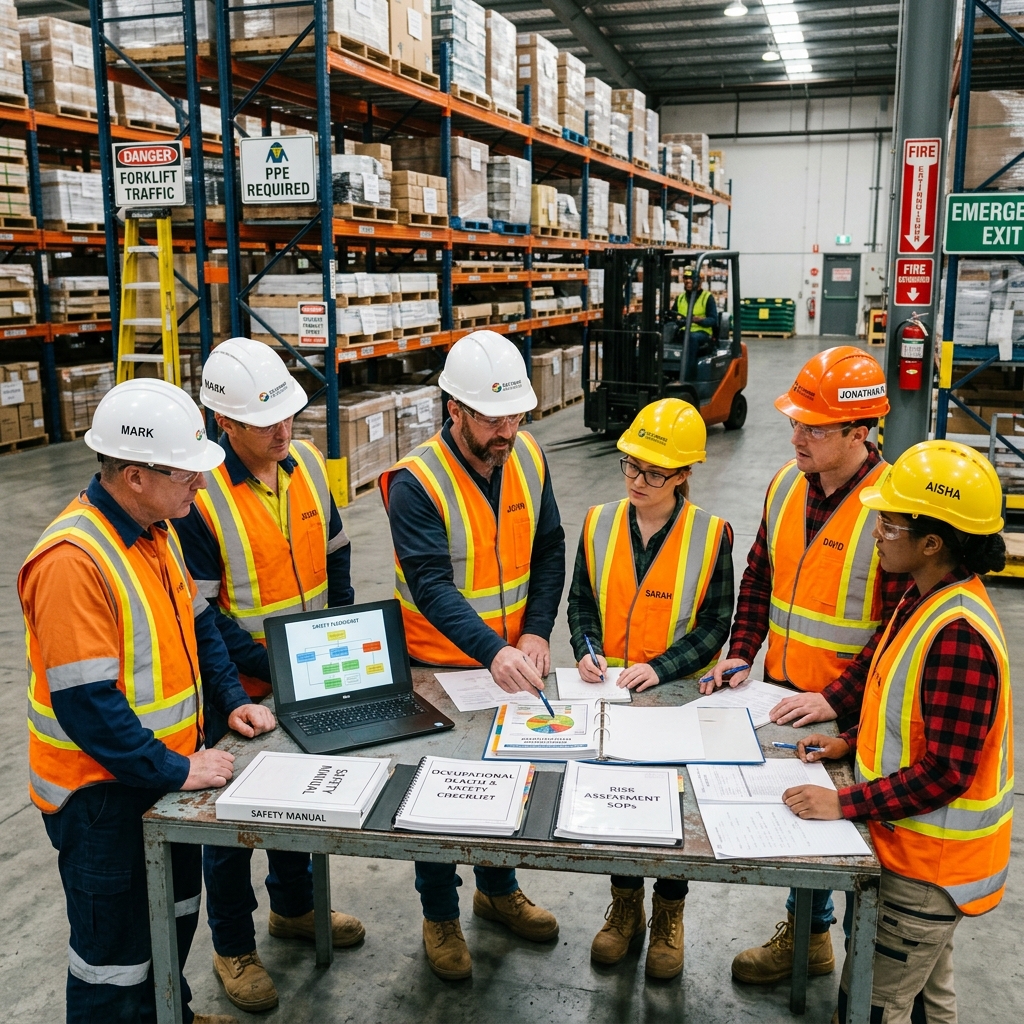
Human and Organizational Performance: A Smarter Way to Manage Safety
Most safety programs were built on a simple belief: people are the problem. If a worker made a mistake, you retrained them, disciplined them, or replaced them. Yet incident rates kept climbing, and frontline teams kept their heads down. Human and Organizational Performance offers a different path. Human and Organizational Performance, often shortened to HOP, is an operating philosophy that treats people as problem solvers rather than problems to manage. It uses social sciences to understand how workers, systems, and organizational culture interact. The goal is to build safer, more reliable workplaces by learning from mistakes instead of punishing the people who make them. This article breaks down what HOP is, the five principles that anchor it, the benefits it delivers, and a practical roadmap for bringing it to life in your organization. Whether you manage safety in manufacturing, construction, or healthcare, these ideas can reshape how your team responds to error and risk. Safety Knights home: https://safetyknights.com
What is Human and Organizational Performance in safety?
Human and Organizational Performance is a comprehensive framework for safety professionals that examines the complex relationship between people and the systems they work within. Rather than viewing human error as the end of an investigation, HOP treats it as a starting point for learning. The approach considers three core factors: the human contribution, the organizational culture, and the existing systems built to catch and mitigate incidents. By looking at all three together, HOP helps organizations design safer work instead of simply blaming the worker closest to the failure. Safety practitioners describe HOP as a fundamental shift in how we view people. Traditional safety often starts from a place of distrust, treating employees as the last problem to fix. HOP starts from trust, recognizing that workers show up to do a good job and hold vital knowledge about how work actually happens. Safety Knights articles: https://safetyknights.com/content/articlesWhat are the 5 principles of Human and Organizational Performance?
The foundation of HOP rests on five principles, popularized by Dr. Todd Conklin in his book "The 5 Principles of Human Performance." These principles guide every decision, conversation, and investigation in a HOP-focused organization. - Error is normal: Every person, including your top performers, will make mistakes. No one chooses to fail. Because error is inevitable, fine-tuning systems is far more effective than trying to perfect human behavior. - Blame fixes nothing: Assigning blame creates fear and defensiveness. When people are afraid, they hide the truth, and your organization loses access to the information it needs to improve. - Context drives behavior: People act in response to their environment. To understand why something went wrong, you have to understand the conditions, pressures, and circumstances that shaped the decision. - Learning is vital: Improvement only happens through learning. Treating failures as opportunities to understand the system helps teams uncover root causes and build better safeguards. - How you respond matters: A leader's reaction to an error sets the tone for the entire organization. Respond with curiosity and the team learns. Respond with punishment and the team goes silent. These principles work as a set. Lean into them harder when progress stalls or the organization slips back into old habits. Safety Knights mission: https://safetyknights.com/missionWhy does Human and Organizational Performance improve workplace safety?
HOP delivers measurable advantages for organizations willing to shift their mindset. It moves safety from a reactive, blame-driven process to a proactive, learning-driven one. - Optimized safety: HOP identifies underlying risks before incidents occur by analyzing systems holistically rather than pinning failure on individuals. - Stronger risk management: Recognizing that humans are fallible pushes organizations to redesign processes and procedures that invite error in the first place. - Higher employee engagement: When workers can learn from mistakes without fear, they bring more attention, collaboration, and honesty to their work. - Better decision-making: Considering human factors and system complexity together leads to more informed, less biased choices. - Greater reliability and resilience: Learning from near-misses and incidents helps organizations recover quickly and adapt to changing conditions. For safety leaders under pressure to reduce incident rates and pass compliance audits, these outcomes hit the metrics that matter most. NIOSH Total Worker Health: https://www.cdc.gov/niosh/twh/How do you implement Human and Organizational Performance in your organization?
HOP is not a program you roll out with a fixed timeline and a checklist. It is an operating philosophy you grow over time by reshaping beliefs around error, blame, and learning. That said, a flexible roadmap helps you move in the right direction. Safety consultants commonly outline five phases of HOP integration that many practitioners now use as a guide. - Leadership interest: Build relationships with leaders, mentor them through challenges, and make the case for change. Most of your early effort should focus here, since HOP is led from the top down, not pushed onto the frontline. - Building HOP fluency: Educate your organization through fundamentals training and learning teams. Over time, your company will begin to "speak HOP." - Operational learning: Use learning teams to study how everyday work happens, not just what went wrong after an event. Learn on purpose, before incidents occur. - Alignment: Embed HOP principles into your existing systems and declutter rules and processes that no longer serve a purpose. - Safeguard management: Use the intelligence gathered through operational learning to continuously design and improve your lifesaving controls. If a full rollout feels overwhelming, start small. Pick a single pain point or task and run a learning team to understand it better. These conversations are low risk and high reward, and they prove the value of doing things differently. Safety Knights podcasts: https://safetyknights.com/podcastsIs Human and Organizational Performance too soft for serious safety work?
A common criticism is that HOP is too "fluffy" or "soft," especially from leaders used to command-and-control management. The reality is the opposite. HOP digs into the raw and real stories of how work actually goes, including near-death experiences and the moments workers feel forced to choose between honesty and their jobs. There is nothing soft about hearing those accounts. Leaders who have adopted the approach often note that HOP lets them hear the raw and the real, which is exactly what they need to make better decisions. By removing the fear of blame, HOP surfaces the operational truth that punitive systems bury. That truth is what allows leaders to fix the conditions driving risk, rather than chasing symptoms. Safety Knights community: https://safetyknights.com/join-usThe journey is worth the effort
Adopting Human and Organizational Performance is a long, sometimes slow process. Your organization will hit roadblocks and occasionally slip back into old patterns. Progress often shows up in small things, like a worker sharing an honest story about a near-miss, or a leader responding to an error with curiosity instead of discipline. Start by listening to the stories already circulating in your workplace. Are they stories of learning, or stories of blame and fear? The answer tells you where you stand and where to begin. Pick one principle, run one learning team, and let the results build momentum. Your people, and your safety record, are worth the investment. Safety Knights content: https://safetyknights.com/contentFAQ
Below are answers to some of the most common questions safety professionals ask about Human and Organizational Performance and how it works in practice.Who created the principles of Human and Organizational Performance?
Dr. Todd Conklin popularized the five principles of human performance through his books and decades of work in the safety field, including his time at Los Alamos National Laboratory. Practitioners like Andrea Baker and Sam Goodman have since expanded the body of knowledge with practical guides for implementation.How is HOP different from traditional safety programs?
Traditional safety programs often treat people as the cause of incidents and rely on rules, surveillance, and discipline. HOP treats people as problem solvers, focuses on improving systems and context, and replaces blame with learning. The shift is from controlling behavior to understanding and improving the conditions of work.How long does it take to implement HOP?
There is no fixed timeline. HOP is an operating philosophy that grows over time as beliefs and culture shift, so the journey is ongoing rather than a project with an end date. Many organizations see early wins within months by running a few learning teams, while deeper cultural change takes years.What is a learning team in HOP?
A learning team is a structured conversation where workers who do the job share how work actually happens. The goal is to gather context-rich information about normal work and operational risk, both after an event and proactively before one occurs. Learning teams are one of the easiest ways to begin practicing HOP.Can HOP work without full leadership buy-in?
Yes. Some organizations grow HOP "backwards," starting at a local or team level with support from a supervisor or manager rather than executives. These grassroots efforts can act as bright spots that demonstrate success and eventually win broader leadership interest across the organization.Building a Safer Future Through Trust and Learning
Human and Organizational Performance gives safety professionals a smarter, more honest way to manage risk. By treating workers as problem solvers, replacing blame with curiosity, and learning from the work as it actually happens, organizations build systems that catch error before it causes harm. The path takes time, but the payoff is a safer workforce and a culture worth being part of. Safety Knights guidelines: https://safetyknights.com/guidelines
Building A Resilient Manufacturing Safety Program In 2026
The manufacturing sector remains the backbone of global industry, but it inherently involves significant operational risks. For environmental, health, and safety professionals, protecting workers on the factory floor is a daily challenge that requires rigorous planning, continuous education, and a proactive culture. As production lines become more complex and regulatory bodies tighten their oversight, relying on outdated safety manuals is no longer sufficient to mitigate workplace hazards effectively. Safety professionals must develop dynamic systems that not only ensure compliance with the Occupational Safety and Health Administration (OSHA) and other regulatory bodies but also actively engage employees at every level. A robust safety initiative goes beyond merely checking boxes on an audit form; it empowers workers, reduces costly operational downtime, and fosters a community where everyone feels responsible for identifying and correcting hazards before incidents occur. Upgrading your risk management approach is crucial for both compliance and organizational success. By integrating modern training methodologies, leveraging real-time reporting tools, and adhering to updated national guidelines, safety leaders can transform their facilities into highly efficient, secure environments. Safety Knights community: https://safetyknights.com/join-us
The True Financial and Cultural Cost of Manufacturing Injuries
Understanding the widespread impact of workplace incidents is the first step toward securing executive buy-in for safety improvements. The Bureau of Labor Statistics (BLS) consistently reports that the manufacturing industry experiences a high volume of nonfatal occupational injuries and illnesses. In recent years, the total recordable case (TRC) incidence rate for manufacturing has hovered around 3.4 cases per 100 full-time equivalent workers. These statistics represent more than just numbers on a page; they reflect severe disruptions to productivity, massive workers' compensation payouts, and diminished employee morale. The direct costs of an incident, including medical expenses and legal fees, are only the tip of the iceberg. Indirect costs, such as investigating the incident, repairing damaged equipment, training replacement workers, and managing reputational damage, can be significantly higher. Investing in a comprehensive safety infrastructure yields a substantial return on investment. Research and historical data from regulatory agencies suggest that for every dollar invested in effective safety protocols, organizations can save up to six dollars in incident-related costs. This financial reality makes risk management an undeniable business imperative. OSHA business case for safety: https://www.osha.gov/businesscase/costsCore Elements of an Effective Manufacturing Safety Initiative
Establishing a functional and compliant safety infrastructure requires a structured approach that addresses every facet of the operational environment. Management must move away from reactive fixes and embrace a framework designed to anticipate and neutralize threats proactively. The most successful facilities implement programs based on proven regulatory guidelines. These frameworks typically revolve around several foundational pillars that work together to create a continuous loop of improvement, assessment, and communication.Management Leadership and Active Worker Participation
A safety program will falter without visible, unwavering commitment from the top. Executive leadership must allocate adequate resources, set clear safety goals, and demonstrate that worker well-being takes precedence over production speed. When leaders actively participate in safety walk-throughs and openly discuss hazard mitigation, it sets a powerful precedent for the entire organization. Equally important is the empowerment of the workers themselves. Employees on the factory floor are the most familiar with the daily hazards of their specific tasks. Encouraging them to report near-misses without fear of retaliation, involving them in risk assessment committees, and valuing their input during incident investigations ensures the program is grounded in operational reality. Safety Knights articles: https://safetyknights.com/content/articlesComprehensive Hazard Identification and Assessment
You cannot mitigate a risk you do not know exists. A cornerstone of any resilient program is the continuous identification and evaluation of workplace hazards. This involves routine facility inspections, equipment maintenance checks, and the thorough review of any new chemicals or machinery introduced to the production line. Effective hazard assessment also requires analyzing historical incident data to identify troubling trends. If a specific production area shows a high frequency of minor injuries, safety officers can focus their investigative efforts there to uncover the root cause and implement targeted preventative controls.Implementation of Preventative Controls
Once hazards are identified, safety teams must establish robust controls to eliminate or minimize them. This follows the hierarchy of controls, starting with the physical elimination of the hazard, followed by substitution, engineering controls, administrative controls, and finally, the provision of personal protective equipment (PPE). Modern manufacturing facilities are increasingly turning to advanced safety technologies, such as automated machine guarding and real-time environmental monitoring sensors, to provide an additional layer of protection. Combining these physical controls with clear administrative procedures ensures a safer operational workflow. Safety Knights mission: https://safetyknights.com/missionThe 2026 OSHA Safety Champions Initiative
In March 2026, the Department of Labor introduced a cooperative initiative designed to help employers develop and implement highly effective safety and health systems. The OSHA Safety Champions Program represents a significant shift toward collaborative, continuous improvement in workplace safety. The initiative meets businesses where they are on their compliance journey, offering three progressive tiers: Introductory, Intermediate, and Advanced. This structured pathway allows facilities to adopt best practices tailored to their specific operational needs and gradually build a more sophisticated risk management framework.Aligning with the Seven Essential Elements
Participants in the Safety Champions Program are encouraged to integrate seven essential elements into their daily operations. These include management leadership, worker participation, hazard identification, prevention and control, education and training, program evaluation, and transparent communication. By focusing on these specific areas, manufacturing safety officers can ensure their facilities do not merely meet baseline regulatory requirements but actively excel in protecting their workforce. Employers can choose to navigate these steps independently or collaborate with Special Government Employees for dedicated technical assistance. OSHA Safety Champions Program: https://www.osha.gov/news/newsreleases/osha-national-news-release/20260316Fostering a Proactive Safety Culture Through Ongoing Education
Initial onboarding is never enough to sustain a safe manufacturing environment. Continuous education and scenario-based training are vital for keeping hazard awareness top-of-mind and ensuring compliance with evolving NEBOSH and OSHA standards. Training modules should be dynamic, easily accessible, and tailored to the specific roles within the facility. When workers understand not just how to perform a task safely, but why the safety protocols exist, compliance rates increase dramatically.Leveraging Real-Time Incident Reporting
Cumbersome, paper-based incident reporting discourages employees from logging near-misses and minor hazards. Streamlining the reporting process with accessible, user-friendly digital tools saves time and significantly improves the accuracy of the data collected. When safety managers have access to real-time compliance insights and incident reports, they can swiftly deploy mitigation strategies. Insightful risk management dashboards allow leaders to track audit readiness and respond to emerging threats before they escalate into recordable injuries. Safety Knights podcasts: https://safetyknights.com/podcastsEmpowering the Safety Team
Safety professionals often face the daunting task of managing vast amounts of regulatory documentation while actively patrolling the factory floor. Equipping these teams with the right resources, clear communication channels, and ongoing professional development ensures they remain effective and motivated. Unlike many competitive industries, the safety profession thrives on collaboration and shared knowledge. Building an internal community where safety officers, floor managers, and shift supervisors regularly exchange insights leads to a more cohesive and responsive safety culture. Safety Knights hustles: https://safetyknights.com/hustlesEvaluating and Updating Your Safety Infrastructure
A stagnant safety initiative is a vulnerable one. Operational environments in manufacturing are constantly in flux, with new equipment, shifting production goals, and changing personnel. Therefore, your safety protocols must be subjected to regular audits and comprehensive evaluations. Safety leaders should conduct annual reviews of their incident rates, training completion metrics, and compliance audit pass rates. If the data indicates an increase in minor injuries or a drop in reporting, it signals that the program requires immediate adjustment and reinforced executive support.Preparing for Regulatory Audits
Audit readiness should not be a frantic scramble that occurs once a year. By maintaining accurate, real-time records of hazard assessments, preventative maintenance, and employee training, facilities can ensure they are perpetually prepared for regulatory inspections. Proactive compliance tracking eliminates the stress of unexpected audits and demonstrates to regulatory bodies that the organization takes its legal and moral obligations to worker safety seriously. Bureau of Labor Statistics injury data: https://www.bls.gov/iif/FAQ
Navigating the complexities of industrial risk management often raises questions about compliance, strategy, and implementation. Below are answers to some of the most common inquiries safety professionals have when upgrading their manufacturing safety frameworks.What are the core components of a manufacturing safety program?
An effective framework includes visible management leadership, active worker participation, continuous hazard identification, robust preventative controls, ongoing education and training, and routine program evaluation. Integrating these elements ensures a proactive approach to risk management rather than a reactive one.How does the OSHA Safety Champions Program benefit manufacturers?
Launched in 2026, this cooperative initiative provides a structured, three-tiered pathway (Introductory, Intermediate, and Advanced) to help facilities develop superior safety systems. It offers technical guidance, encourages continuous improvement, and aligns organizational practices with OSHA's seven essential elements of workplace safety.What is the financial return on investment for safety training?
Investing in comprehensive safety training and infrastructure significantly reduces direct and indirect costs associated with workplace injuries. Regulatory research indicates that for every dollar spent on effective safety protocols, organizations can save up to six dollars by preventing operational downtime, workers' compensation claims, and equipment damage.How can technology improve incident reporting on the factory floor?
Replacing manual, paper-based logging with digital, real-time reporting tools streamlines the documentation process. This saves time, improves data accuracy, and allows safety managers to access insightful dashboards, enabling them to quickly identify hazard trends and implement swift mitigation strategies.Why is worker participation crucial for hazard assessment?
Employees operating the machinery and handling the materials are intimately familiar with the daily realities and hidden risks of their tasks. Encouraging their active participation in safety committees and near-miss reporting ensures that hazard assessments are grounded in actual floor conditions, leading to more practical and effective safety controls.Setting the Standard for Industrial Safety Excellence
The landscape of industrial risk management is continually evolving, demanding that professionals remain vigilant, educated, and deeply connected to their workforce. By prioritizing proactive hazard identification, embracing collaborative initiatives, and fostering a culture of continuous learning, organizations can drastically reduce incidents and protect their most valuable asset. Empowering your team with the right knowledge and streamlined reporting tools ensures that your facility not only meets stringent regulatory standards but sets a benchmark for operational excellence. Safety Knights home: https://safetyknights.com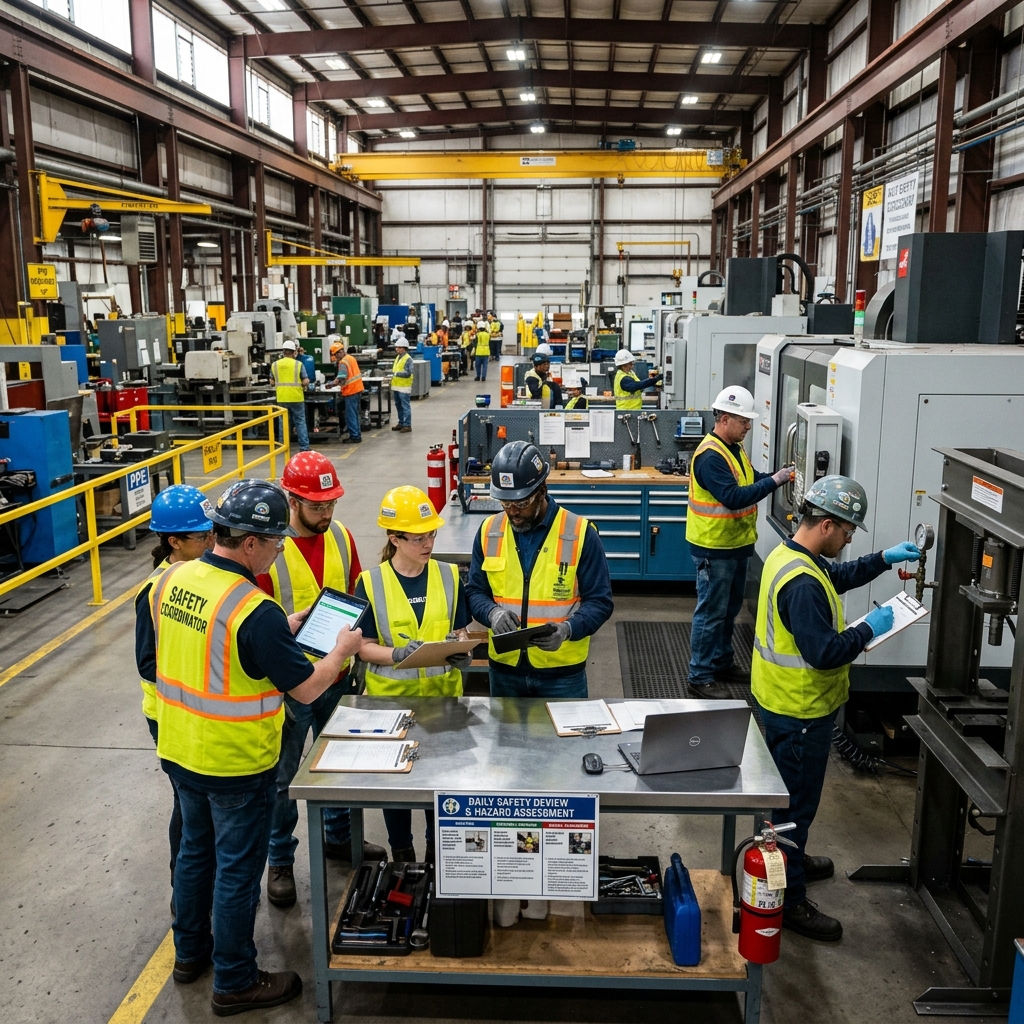
Unlock Your Potential: The Ultimate Guide To Earning A Safety Management Certificate
In the dynamic world of environmental health and safety, standing out requires more than just experience. While time on the job teaches you the practical realities of hazard mitigation and risk assessment, formal credentials validate that knowledge against global standards. Whether you are looking to secure a promotion, pivot into a new industry, or simply sharpen your skills, earning a safety management certificate is often the catalyst for significant career growth. Navigating the landscape of certifications, certificates, and continuing education units can feel overwhelming. There are dozens of acronyms, various governing boards, and differing prerequisites for every program. However, understanding these options is the first step toward empowering your career and enhancing the safety culture within your organization. Safety Knights home: https://safetyknights.com This guide explores the tangible benefits of pursuing advanced safety education, breaks down the differences between various credentials, and helps you identify the right path for your professional journey. By the end, you will have a clear roadmap to becoming a more credentialed, confident, and capable safety leader.
Why Pursue a Safety Management Certificate?
The decision to invest time and money into a safety certificate is not one to take lightly, but the return on investment is often substantial. Beyond the obvious benefit of adding letters after your name, these programs offer a structured way to deepen your understanding of regulatory compliance and safety methodologies. First and foremost, credentials signal competency to employers. When a hiring manager sees a recognized certificate on a resume, they immediately know that the candidate possesses a baseline level of knowledge and dedication to the profession. In a competitive job market, this can be the deciding factor between landing an interview or being passed over. Safety Knights community: https://safetyknights.com/join-us Financial incentives are another major driver. According to industry salary surveys conducted by the Board of Certified Safety Professionals (BCSP), safety professionals with at least one certification typically earn significantly more than their non-certified counterparts. This salary gap often widens as professionals gain more advanced credentials and move into leadership roles. Finally, the process of earning a certificate keeps you sharp. Regulations from OSHA and other governing bodies are constantly evolving. Engaging in a certificate program forces you to stay current with the latest standards, technologies, and best practices, ensuring you are providing the best possible protection for your workforce.Certificate vs. Certification: Understanding the Distinction
Before diving into specific programs, it is crucial to clarify the terminology. The terms "certificate" and "certification" are often used interchangeably, but they represent two very different types of recognition in the safety industry. Understanding this difference will help you choose the educational path that aligns with your specific goals. A certificate program is typically educational in nature. It is designed to teach you a specific set of learning objectives. Once you complete the coursework and pass an assessment to prove you learned the material, you are awarded a certificate. These are excellent for acquiring new knowledge or specializing in a niche area, such as hazardous materials management or construction safety. Safety Knights articles: https://safetyknights.com/content/articles On the other hand, a professional certification is a third-party validation of your existing knowledge, skills, and experience. Certifications, like the Certified Safety Professional (CSP), usually require you to meet strict eligibility requirements regarding education and work experience before you can even sit for the exam. They are not tied to a specific course but rather test your overall competency in the field. Both paths have value. A certificate is often a stepping stone toward certification, providing the educational hours and foundational knowledge needed to qualify for the more rigorous exams later in your career.Top Safety Management Certificates and Certifications
The safety industry offers a wide array of credentials catering to different experience levels and industries. Below are some of the most respected and recognized designations that can elevate your standing as a safety professional.Associate Safety Professional (ASP)
The Associate Safety Professional (ASP) designation is often considered the first major milestone for safety practitioners. Offered by the BCSP, this certification demonstrates that you have mastered the fundamental concepts of safety management. It serves as a prerequisite for the more advanced CSP certification. To qualify for the ASP, you typically need a bachelor's degree and at least one year of safety experience where safety is at least 50% of your preventive, professional level duties. The exam covers a broad range of topics, including mathematics, safety management systems, ergonomics, and fire prevention. Board of Certified Safety Professionals: https://www.bcsp.orgCertified Safety Professional (CSP)
The Gold Standard in safety certification is widely considered to be the Certified Safety Professional (CSP). This designation is held by leaders in the field and is often a requirement for high-level management positions. It validates a professional's ability to perform at a professional level of safety practice. Qualifying for the CSP is rigorous. You must already hold a foundational credential (like the ASP or GSP), possess a bachelor's degree, and have four years of professional safety experience. The exam focuses on advanced topics such as risk management, advanced safety concepts, and business principles.Safety Management Specialist (SMS)
For those who have taken a different path—perhaps moving into safety from an operational or management role—the Safety Management Specialist (SMS) certification is an excellent option. This designation is designed for experienced professionals who are responsible for managing safety programs but may not have the specific math or science background required for the ASP or CSP. The SMS focuses on the management aspect of safety: defining and applying safety systems, risk management, and incident investigation. It recognizes that effective safety leadership requires a unique set of skills that bridges the gap between technical safety knowledge and business operations.Occupational Health and Safety Technologist (OHST)
If your role is focused on the technical implementation of safety programs rather than high-level management, the Occupational Health and Safety Technologist (OHST) certification might be the right fit. This is ideal for individuals who perform occupational health and safety activities on a full-time or part-time basis. OHSTs are often the boots on the ground, conducting audits, performing industrial hygiene monitoring, and training employees. This certification validates your technical proficiency and ability to identify hazards in the workplace effectively.Certified Safety and Health Manager (CSHM)
Offered by the Institute for Safety and Health Management (ISHM), the Certified Safety and Health Manager (CSHM) designation is targeted at professionals who demonstrate a knowledge of safety management skills and techniques. It emphasizes the business aspect of safety, focusing on how to integrate safety into the overall organizational structure. This credential is particularly valuable for those who need to communicate the value of safety to the C-suite. It covers topics like financial analysis, organizational behavior, and leadership, equipping you with the language needed to justify safety budgets and initiatives.Choosing the Right Program for Your Career Path
With so many options available, selecting the right safety management certificate can be daunting. It is helpful to analyze your current position, your future goals, and the specific needs of your industry. Start by assessing your experience level. If you are new to the field, look for certificate programs offered by universities or OSHA Education Centers. These programs often have fewer prerequisites and focus on building a strong foundation of knowledge. OSHA Education Centers: https://www.osha.gov/otiec When evaluating your options: - Review job descriptions for roles you aspire to hold. - Identify which certifications are consistently listed as "required" or "preferred." - Consider the specific hazards relevant to your industry (e.g., construction vs. healthcare). - Evaluate your budget and the time you can commit to study. If you are working in a highly specialized field, such as oil and gas or healthcare, look for credentials that cater to those unique environments. Generalist certifications are valuable, but specialized knowledge can make you indispensable in niche markets.The Role of Education in Compliance and Risk Mitigation
Beyond personal career advancement, earning a safety management certificate has a direct impact on your organization's ability to remain compliant and reduce risk. Education empowers you to look beyond the surface of regulations and understand the "why" behind the rules. When you understand the principles of risk assessment and hazard mitigation at a deeper level, you can develop more effective safety programs. Instead of simply checking boxes, you can implement proactive measures that prevent incidents before they occur. This shift from reactive to proactive safety management is the hallmark of a high-functioning safety culture. Safety Knights mission: https://safetyknights.com/mission Furthermore, educated safety professionals are better equipped to handle audits and inspections. Knowing exactly what regulators are looking for—and being able to demonstrate that your programs meet those standards—can save your company thousands of dollars in fines and legal fees.Preparing for Your Certification Exam
Deciding to pursue a certification is the easy part; passing the exam is where the real work begins. Safety certification exams are notoriously difficult, covering a vast amount of technical and managerial material. Success requires a strategic approach to studying. Create a study plan that spans several months. Cramming for a comprehensive exam like the CSP is rarely successful. Dedicate small, consistent blocks of time to review specific domains. Effective preparation strategies include: - Utilize official study guides and blueprints provided by the certifying board. - Join study groups or local chapters of safety organizations to share resources. - Take practice exams to identify weak areas and get comfortable with the testing format. - Focus on understanding concepts rather than memorizing facts. Many professionals find value in taking review courses. These intensive workshops, often held over a few days, provide a focused review of the exam material and offer test-taking strategies. While they can be an additional expense, the investment is often worth it if it helps you pass on the first try. Safety Knights written programs: https://safetyknights.com/content/written-programsMaintaining Your Credential: The Importance of Continuing Education
Earning your certificate is a major achievement, but it is not the finish line. Most respected safety certifications require you to maintain your status through continuing education. This ensures that certified professionals remain competent and up-to-date with industry changes. Recertification cycles typically last three to five years. During this time, you must earn a specific number of Continuing Education Units (CEUs) or recertification points. These can be earned through various activities, such as attending conferences, taking college courses, publishing articles, or presenting at seminars. Safety Knights podcasts: https://safetyknights.com/podcasts Viewing continuing education as an opportunity rather than a burden is a healthy mindset shift. It encourages lifelong learning and networking. Attending industry conferences, for example, allows you to connect with peers, learn about emerging technologies, and bring fresh ideas back to your workplace.The Future of Safety Management Credentials
The safety profession is evolving rapidly. As technology changes the way we work, new hazards emerge, and old ones transform. The rise of automation, artificial intelligence, and remote work is creating a demand for safety professionals who are adaptable and tech-savvy. Certification boards are responding by updating their exam blueprints to include these modern challenges. Future safety leaders will need to demonstrate competency in areas like psychological safety, data analytics, and sustainability. Earning a safety management certificate today lays the groundwork for navigating these future complexities. Employers are increasingly valuing soft skills alongside technical expertise. Modern certificate programs are placing greater emphasis on communication, leadership, and emotional intelligence. Being able to influence behavior and lead diverse teams is becoming just as important as knowing how to calculate an incident rate.Taking the Next Step
Your journey toward a safety management certificate is a commitment to excellence. It is a declaration that you value the well-being of the workforce and are dedicated to the highest standards of the profession. Whether you choose to pursue the ASP, CSP, or a specialized certificate, the knowledge you gain will pay dividends throughout your career. You will be better positioned to protect workers, guide your organization through complex regulatory landscapes, and lead with confidence. Safety Knights content: https://safetyknights.com/content Start by researching the prerequisites for the credentials that interest you. Talk to your employer about support for tuition or exam fees. Reach out to mentors in the field who hold the designations you admire. The path to certification is challenging, but you do not have to walk it alone.FAQ
Below are answers to common questions regarding safety management certificates and the certification process for safety professionals.What is the difference between a certificate and a certification in safety?
A certificate is usually awarded after completing a specific educational course or training program, proving you have acquired new knowledge. A professional certification, like the CSP, is a third-party validation of your existing experience and competency, usually requiring a comprehensive exam and specific prerequisites.Do I need a college degree to get a safety certification?
It depends on the specific certification. The CSP and ASP generally require at least a bachelor's degree. However, other certifications like the OHST, CSHM, or SMS have different requirements that may accept a combination of experience and an associate degree or high school diploma.How much does it cost to get certified?
Costs vary significantly. Application fees can range from $150 to $200, and exam fees typically run between $300 and $400. Additionally, you should budget for study materials, review courses, and annual renewal fees to maintain the credential.Will my employer pay for my safety certification?
Many employers recognize the value of having certified staff and are willing to pay for exams, study materials, and continuing education. It is worth presenting a business case to your management highlighting how your certification will benefit the organization through better compliance and risk reduction.How do I maintain my safety certification once I have it?
Most certifications require you to earn Continuing Education Units (CEUs) or recertification points over a cycle, usually every 3 to 5 years. You can earn points by attending conferences, taking courses, teaching, or participating in professional safety organizations.Is the CSP exam difficult?
Yes, the CSP exam is considered rigorous. It covers a wide range of topics including advanced science, math, management, and legal principles. Pass rates vary, but comprehensive preparation and study are essential for success.Future-Proofing Your Safety Career
Investing in your education is the single most effective way to future-proof your career in safety. By choosing to pursue a safety management certificate, you are taking proactive steps to ensure you remain a valuable asset to your team and a guardian of workplace safety. Safety Knights milestones: https://safetyknights.com/milestones
The Ultimate Guide To EHS Certification: Elevate Your Safety Career
In the dynamic world of Environmental, Health, and Safety (EHS), experience is invaluable, but certification is the currency of credibility. Whether you are a seasoned safety veteran looking to validate years of hard work or a newcomer eager to make your mark, navigating the maze of available certifications can feel overwhelming. It is not just about adding letters after your name; it is about demonstrating a commitment to protecting people, property, and the environment. Choosing the right path requires understanding where the industry is heading and what employers truly value. Certification distinguishes you as a leader who understands the nuances of regulatory compliance, risk assessment, and safety culture. It signals to your organization and your peers that you adhere to the highest standards of professional practice. Safety Knights community: https://safetyknights.com/join-us
Understanding EHS Certification vs. Certificate Programs
Before diving into specific credentials, it is crucial to clarify a common point of confusion in our industry. There is a distinct difference between holding a professional certification and completing a certificate program. While both are valuable, they serve different purposes in your career development. A certificate program typically results from a training course where you acquire new knowledge and are tested on that specific content at the end. For example, completing a confined space entry course or a 30-hour OSHA training class rewards you with a certificate or card. It proves you attended the training and understood the material presented. In contrast, a professional certification is a credential awarded by a third-party standard-setting organization, such as the Board of Certified Safety Professionals (BCSP). These certifications require you to meet specific eligibility requirements involving education and experience, pass a rigorous comprehensive exam, and maintain the credential through ongoing continuing education. Safety Knights home: https://safetyknights.comThe Gold Standard: Board of Certified Safety Professionals (BCSP)
For safety professionals in the United States and increasingly abroad, the BCSP offers the most recognized and respected credentials. Holding a BCSP certification often translates directly to higher salary potential and greater leadership opportunities within an organization.Certified Safety Professional (CSP)
The CSP is often considered the pinnacle of safety certifications. It is designed for professionals who perform at least 50% of professional-level safety duties, including making worksite assessments, determining risk, ensuring compliance, and investigating incidents. To become a CSP, you must have a bachelor's degree, four years of professional safety experience, and you must already hold a qualified credential like the ASP or GSP. It is a rigorous process that validates your ability to manage complex safety management systems.Associate Safety Professional (ASP)
The ASP is the ideal starting point for many professionals on their way to the CSP. It demonstrates a solid grasp of safety fundamentals. The requirements are slightly more accessible, requiring a bachelor's degree (or an associate degree with specific coursework) and one year of safety experience. Many professionals hold the ASP for a few years while gaining the requisite experience to sit for the CSP exam. It is a powerful standalone credential that proves you have moved beyond basic safety oversight into technical safety management. Safety Knights content: https://safetyknights.com/contentConstruction Health and Safety Technician (CHST)
If your focus is specifically on the construction industry, the CHST is a highly specialized and valuable credential. It is designed for safety practitioners who work on construction sites and are responsible for preventing illnesses and injuries. Unlike the CSP, the CHST does not require a bachelor's degree, making it an excellent option for those who have come up through the trades and moved into a safety role. It requires three years of construction experience with at least 35% of duties related to safety.OSHA Outreach Training: The Foundation
While technically not a "certification" in the same vein as the CSP, OSHA Outreach Training cards are ubiquitous in the industry. For many entry-level positions, they are a mandatory prerequisite. These courses provide the foundational knowledge necessary to identify and prevent common workplace hazards.OSHA 10-Hour vs. 30-Hour
The 10-hour class is intended for entry-level workers. It covers basic hazard awareness and workers' rights. It is great for general staff but insufficient for a dedicated safety professional. The 30-hour class is designed for supervisors and workers with some safety responsibility. It dives deeper into hazard identification, avoidance, control, and prevention. If you are starting a career in safety, obtaining your OSHA 30 card for either General Industry or Construction is often step one. OSHA Outreach Training Program: https://www.osha.gov/training/outreachInternational Standards: ISO 45001 and ISO 14001
For EHS professionals working in large multinational organizations or manufacturing, understanding ISO standards is non-negotiable. These are not certifications for individuals in the traditional sense, but becoming a certified auditor for these systems is a distinct career path.ISO 45001: Occupational Health and Safety
ISO 45001 is the international standard for occupational health and safety management systems. It provides a framework for organizations to proactively improve employee safety, reduce workplace risks, and create better, safer working conditions. Professionals can become certified Lead Auditors for ISO 45001. This credential proves you have the expertise to audit an organization's safety management system against the standard, a skill highly prized in corporate compliance roles. ISO 45001 overview: https://www.iso.org/standard/63787.htmlISO 14001: Environmental Management
On the environmental side of EHS, ISO 14001 sets the criteria for an environmental management system. It maps out a framework that a company or organization can follow to set up an effective environmental management system. Having a deep understanding of this standard allows EHS professionals to guide their companies toward sustainability and compliance. Certification courses for implementing or auditing ISO 14001 are widely available and serve as a strong bolster to your resume. ISO 14001 overview: https://www.iso.org/standard/60857.htmlSpecialized Environmental Certifications
For those whose role leans heavily into the "E" of EHS, general safety certifications might not cover enough ground. Environmental compliance is complex, involving strict adherence to EPA regulations and waste management protocols. The Institute of Hazardous Materials Management (IHMM) offers the Certified Hazardous Materials Manager (CHMM) credential. This is ideal for professionals handling hazardous materials, waste management, and environmental protection. It signals a high level of competence in regulatory compliance and science-based risk mitigation. Another route is through the Institute of Environmental Management and Assessment (IEMA), which offers the Certificate in Sustainability and Environmental Management. This is globally recognized and demonstrates a capability to manage sustainability and environmental risks at an operational level. Safety Knights written programs: https://safetyknights.com/content/written-programsWhy Pursue EHS Certification?
The investment of time and money into certification is significant, but the returns are tangible. The most obvious benefit is financial. Industry surveys consistently show that certified professionals earn significantly more than their non-certified counterparts—sometimes upwards of $20,000 more annually. Beyond salary, certification offers professional mobility. When you hold a universally recognized credential like the CSP or NEBOSH International General Certificate, employers know exactly what you bring to the table. It validates your skills without you having to explain every detail of your past experience. Safety Knights articles: https://safetyknights.com/content/articles Finally, there is the aspect of confidence. Preparing for these exams forces you to study areas of safety you might not encounter in your daily work. This comprehensive knowledge base allows you to make decisions with greater authority and assurance, knowing they are backed by industry best practices.How to Choose the Right Certification for You
With so many acronyms floating around, selecting the right one depends on your career stage and industry focus. If you are early in your career: - Focus on foundational training like the OSHA 30-hour card. - Look into the Graduate Safety Practitioner (GSP) designation if you are graduating from a qualified academic program. - Consider the Associate Safety Professional (ASP) as your first major milestone. If you are mid-career or leadership focused: - The Certified Safety Professional (CSP) should be your primary target. - If you manage environmental risks, look at the CHMM. - For construction specialists, the CHST validates your field expertise. If you are internationally focused: - Look into NEBOSH certifications, which are highly regarded in Europe, the Middle East, and Asia. - Consider auditor training for ISO 45001 or ISO 14001.A Step-by-Step Guide to Getting Certified
The journey to certification is a marathon, not a sprint. Proper planning is essential to ensure you do not waste time or money on exams you are not yet qualified to take.1. Review Eligibility Requirements
Visit the certifying body's website (like BCSP or IHMM) and download their candidate handbook. Carefully check the education and experience requirements. Do not guess; ensure your degree and years of work history match their specific criteria.2. Gather Documentation
You will likely need university transcripts, proof of employment, and potentially references from other safety professionals. Gathering these documents can take weeks, so start this process early before you even apply.3. Submit Your Application
Pay the application fee and submit your materials. The review process can take anywhere from a few days to a few weeks depending on the organization.4. Develop a Study Plan
Once approved to sit for the exam, do not wing it. These exams cover a vast array of topics, from fire protection and ergonomics to industrial hygiene and training methodology. Invest in a dedicated study guide or a preparatory course.5. Schedule and Take the Exam
Most exams are computer-based and taken at designated testing centers. Schedule your exam for a time when you will be fresh and have had ample time to prepare.Maintaining Your Credentials
Getting certified is a huge achievement, but keeping it requires ongoing effort. Almost all reputable certifications require you to recertify periodically, usually every three to five years. This typically involves earning Continuing Education Units (CEUs) or Certification Maintenance Points. You earn these by attending conferences, taking additional training courses, publishing articles, or being an active member of a professional safety organization. Safety Knights podcasts: https://safetyknights.com/podcasts Failing to maintain your CEUs can result in losing your certification, forcing you to re-apply and re-take the exam—a nightmare scenario for any professional. Treat your CEU tracking as part of your professional hygiene.The Future of Safety Leadership
As regulations evolve and workplaces become more complex with the introduction of automation and AI, the role of the EHS professional is changing. Certification proves that you are not stagnant. It shows that you are a lifelong learner committed to the highest standards of safety excellence. By pursuing these credentials, you are not just advancing your own career; you are elevating the entire profession. You are ensuring that every decision you make is rooted in verified knowledge and ethical practice, ultimately making the workplace safer for everyone who walks through the door.FAQ
Here are answers to some of the most common questions safety professionals ask about navigating the certification landscape and understanding the requirements.What is the difference between CSP and ASP?
The Associate Safety Professional (ASP) is an intermediate credential that demonstrates a grasp of safety fundamentals and often serves as a prerequisite for the Certified Safety Professional (CSP). The CSP is an advanced, mastery-level certification that requires more experience (4 years vs. 1 year) and validates a professional's ability to manage comprehensive safety programs.Does an OSHA 30 card count as a certification?
No, the OSHA 30 card is a certificate of completion for a training course, not a professional certification. While it is a valuable and often required credential for employment, it does not require the rigorous eligibility, examination, and continuing education standards of certifications like the CSP or CHST.Do safety certifications expire?
Yes, most professional safety certifications typically require recertification every 3 to 5 years. To maintain the credential, professionals must pay an annual renewal fee and submit proof of Continuing Education Units (CEUs) to demonstrate they remain active and current in the profession.Can I get certified if I do not have a college degree?
Yes, certain certifications do not require a bachelor's degree. For example, the Construction Health and Safety Technician (CHST) and the Safety Trained Supervisor (STS) from the BCSP are accessible to professionals with specific work experience and training, regardless of their university education.Which certification pays the most?
While salaries vary by industry and location, the Certified Safety Professional (CSP) consistently ranks as one of the highest-paying credentials in the field. Industry salary surveys often show that CSP holders earn a significant premium over their non-certified peers.Is the NEBOSH General Certificate recognized in the USA?
While NEBOSH is a prestigious international certification widely recognized in the UK, Europe, and the Middle East, it is less common in the US compared to BCSP credentials. However, for professionals working for multinational companies with operations abroad, holding a NEBOSH certificate can be a significant asset.Charting Your Certification Path
Choosing the right EHS certification is one of the most impactful career moves a safety professional can make. By aligning your credentials with your career goals, industry focus, and long-term ambitions, you position yourself for greater opportunities and a stronger voice in the profession. Start where you are, pick the credential that fits your next move, and commit to the work it takes to earn it. Safety Knights milestones: https://safetyknights.com/milestones
OSHA Danger Signs: A Complete Guide to 1910.145 Compliance
Workplace hazards are an inevitable reality in industries like manufacturing, construction, and healthcare. Managing these risks requires more than just good intentions and basic training programs. It demands a robust communication system that immediately alerts employees to immediate, life-threatening dangers. This is where OSHA danger signs become a critical component of your risk management strategy. When safety professionals standardize their visual communication, they empower their teams to make safer decisions in real time. A single misunderstood hazard can lead to catastrophic consequences. By thoroughly understanding and implementing the requirements outlined in 29 CFR 1910.145, you ensure your team is audit-ready and protected from severe injuries. OSHA accident prevention sign specifications: https://www.osha.gov/laws-regs/regulations/standardnumber/1910/1910.145
Understanding OSHA Standard 1910.145
The Occupational Safety and Health Administration developed standard 1910.145 to govern the design, application, and use of signs and symbols in the workplace. These specifications apply to any sign intended to identify specific hazards that could harm workers or cause property damage. Consistent visual cues are essential for maintaining a strong safety culture. If a danger sign looks different from one facility to the next, employees may hesitate or misinterpret the severity of the hazard. Uniformity eliminates confusion and ensures immediate recognition across all environments. This regulation covers all safety signs except those designed for streets, highways, and railroads. It also excludes plant bulletin boards and general safety posters, focusing entirely on direct hazard communication. Safety Knights home: https://safetyknights.comThe Hierarchy of Safety Signs
Effective hazard communication relies on a tiered approach to visual warnings. OSHA categorizes signs based on the severity of the risk, ensuring employees understand exactly what level of precaution is required. Danger signs are reserved for the most extreme hazards. These signs indicate an immediate threat where failure to avoid the hazard will result in severe injury or death. High voltage areas, confined spaces with hazardous atmospheres, and active chemical exposure zones typically require these warnings. OSHA top 10 cited standards: https://www.osha.gov/top10citedstandards Warning signs represent a hazard level situated between danger and caution. While not explicitly detailed in the original 1910.145 text, they are widely recognized through ANSI standards integrated by OSHA. These warn of conditions that could potentially cause serious injury or death if ignored. Caution signs alert workers to potential hazards or unsafe practices that could result in minor or moderate injuries. Safety instruction signs convey general messages about health, first aid, and standard safety measures, such as reminding employees to wear appropriate personal protective equipment. Safety Knights content: https://safetyknights.com/contentDesign and Color Specifications for Danger Signs
The visual impact of a danger sign is dictated by strict color and design rules. OSHA requires these signs to feature red, black, and white colors, matching opaque glossy samples specified by ANSI standards. This high-contrast combination is universally recognized as a signal to stop and pay attention. Sign construction must also prioritize physical safety. All signs must be furnished with rounded or blunt corners and be completely free from sharp edges, burrs, or splinters. Fastening devices, such as bolts or screws, must be installed so they do not create an additional projection hazard. ANSI Z535 integration offers additional flexibility for modern safety programs. While you can use the original OSHA formats, you are also permitted to use ANSI Z535 formats, which provide more detailed guidance on pictograms, font sizes, and color-coded headers. Safety Knights community: https://safetyknights.com/join-usAccident Prevention Tags vs. Permanent Signs
While signs provide permanent warnings for static hazards, accident prevention tags are used for temporary, out-of-the-ordinary risks. Tags act as a stopgap measure to prevent accidental injury until the identified hazard is completely eliminated. Tags must contain a signal word, such as "Danger," and a major message that clearly indicates the specific hazardous condition. This signal word must be readable from a minimum distance of five feet, ensuring workers are warned before they enter the immediate hazard zone. OSHA consultation program: https://www.osha.gov/consultation Danger tags are exclusively used in major hazard situations where an immediate threat of death or serious injury exists. They must be affixed as safely and closely as possible to the hazard using a secure method like wire or strong adhesive to prevent unintentional removal. Safety Knights articles: https://safetyknights.com/content/articlesCrafting Clear and Effective Sign Wording
The wording on any danger sign must be concise and easily read. Complex sentences and technical jargon can delay comprehension, which is extremely dangerous when immediate action is required. Your message should contain sufficient information to be easily understood by anyone who might encounter the hazard. The wording must make a positive rather than negative suggestion and remain entirely accurate in fact. Safety Knights podcasts: https://safetyknights.com/podcasts For diverse workplaces, consider incorporating pictograms alongside your text. Visual symbols cross language barriers and drastically improve hazard recognition speed. Bilingual signs are also highly recommended to ensure all team members fully grasp the specific dangers present in their work environment.Strategic Placement and Visibility Practices
A compliant sign is useless if it cannot be seen by the people it is meant to protect. Danger signs must be placed at eye level and in locations where they are immediately noticeable to anyone approaching the hazard area. Consistent placement strategies help build a proactive safety culture. When workers know exactly where to look for hazard warnings on specific machinery or entryways, their situational awareness naturally improves. Lighting conditions play a major role in sign effectiveness. In poorly lit facilities or outdoor environments, signs should be illuminated or manufactured with highly reflective materials. Regular inspections are vital to replace any faded, damaged, or obscured signage promptly. Safety Knights written programs: https://safetyknights.com/content/written-programsThe Cost of Non-Compliance: 2025 OSHA Penalties
Failing to properly identify hazards with correct danger signs is a direct violation of OSHA regulations. Regulatory bodies take these infractions seriously because missing signs directly endanger employee lives. As of January 2025, the financial consequences for safety violations have increased due to annual inflation adjustments. A serious or other-than-serious violation can now cost a company up to $16,550 per individual violation. OSHA penalties information: https://www.osha.gov/penalties For organizations that repeatedly ignore signage requirements or commit willful violations, the penalties are staggering. Willful or repeated violations carry a maximum penalty of $165,514 per violation. Failure to abate an existing violation adds an additional $16,550 per day beyond the abatement date. Investing in proper signage is a fraction of the cost of a single serious citation. More importantly, maintaining a pristine visual communication system protects your most valuable asset, which is the health and well-being of your workforce. Safety Knights milestones: https://safetyknights.com/milestonesFAQ
Understanding the nuances of hazard communication can be challenging for even the most experienced safety professionals. Below are practical answers to some of the most common questions regarding OSHA danger sign compliance.What is the exact color requirement for an OSHA danger sign?
OSHA requires danger signs to feature red, black, and white colors. The specific shades must match the opaque glossy samples specified in ANSI Z53.1-1967 or ANSI Z535.1-2006 standards to ensure uniform recognition across all industries.Can I create custom wording for a danger sign?
Yes, you can use custom wording, provided it is concise, easy to read, and accurate in fact. The message must clearly define the specific hazard and provide enough instruction for employees to safely avoid the immediate danger.When should I use a danger tag instead of a danger sign?
Danger tags are used for temporary, out-of-the-ordinary, or unexpected hazards. They serve as a temporary warning system and must remain securely attached until the specific hazard is completely eliminated or the dangerous operation is finished.Are bilingual danger signs required by OSHA?
While OSHA standard 1910.145 does not explicitly mandate bilingual signs, it does require that the signal word and major message be understandable to all employees. If your workforce includes non-English speakers, bilingual signs or universally recognized pictograms are essential for compliance.Do OSHA danger sign rules apply to construction sites?
Standard 1910.145 is technically for General Industry, but construction sites must follow very similar visual communication rules under 29 CFR 1926.200. Notably, the tag requirements outlined in 1910.145(f) specifically state they do not apply to construction or agriculture.How often should danger signs be inspected?
Safety signs should be inspected regularly as part of your routine facility hazard assessments. Any sign that is faded, damaged, obstructed by new equipment, or no longer securely fastened must be replaced immediately to maintain a safe working environment.Building a Pristine Visual Safety System
Compliant signage is one of the most cost-effective investments a safety program can make. By aligning your facility with the requirements of 1910.145, you protect your workforce from immediate dangers and shield your organization from significant regulatory penalties. Take the time to audit your current signage, refresh anything that has faded or shifted out of place, and build inspection cycles into your routine safety walks. Safety Knights guidelines: https://safetyknights.com/guidelines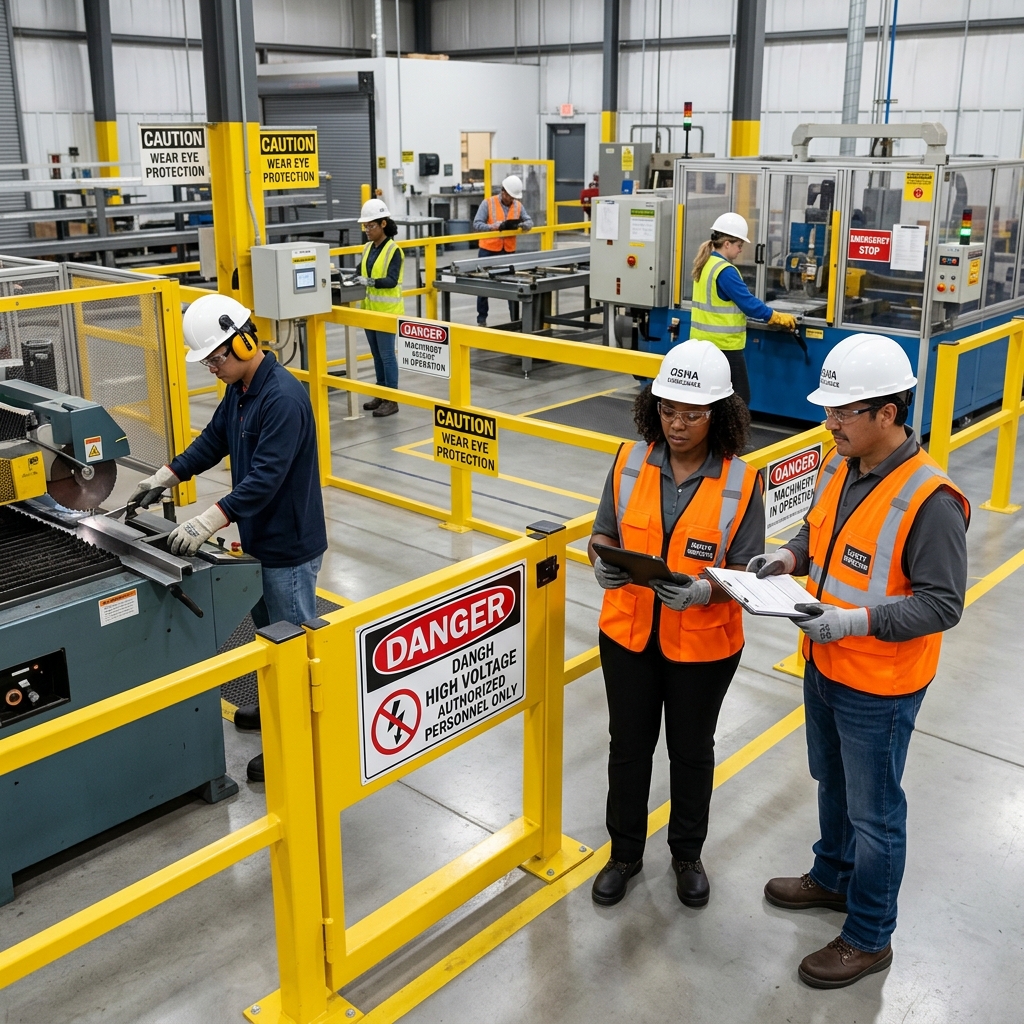
ISO 45003: The New Standard For Psychological Safety In The Workplace
For many years, workplace safety centered on mitigating obvious hazards: machinery, tools, and physical risks. As safety professionals, we know the field has evolved—today, some of the greatest threats to employee well-being are invisible but deeply disruptive. ISO 45003 is a game-changer for those committed to protecting not just the bodies, but also the minds of our teams. Psychosocial risks, including factors related to work design, workplace culture, and organizational systems, are now recognized as essential safety concerns. With ISO 45003's introduction, mental health and psychological safety have been brought into the same risk management conversation as PPE and physical controls. As safety professionals, we have an opportunity to apply systematic practices to support psychological health. If your goal is to make your workplace genuinely safe, understanding and applying ISO 45003's recommendations is a major step forward. Safety Knights mission: https://safetyknights.com/mission
Understanding ISO 45003
ISO 45003 is the first global standard providing formal guidance for managing psychological health and safety at work. Its scope is broad—it helps organizations identify, manage, and mitigate psychosocial risks alongside physical ones. While the standard is not certifiable on its own, it complements ISO 45001. Companies implementing ISO 45001 for occupational health and safety management systems can layer on ISO 45003 to address mental health requirements in a structured way. What makes ISO 45003 especially valuable is its focus on how work is organized, not just the tools or layout of a workplace. The standard directs leaders to consider workload, role clarity, support systems, and workplace relationships, as these all impact psychological safety. Safety Knights home: https://safetyknights.comIs ISO 45003 a Certification Standard?
It's a common question: Can organizations earn certification for ISO 45003? The answer is no, not in the traditional sense. ISO 45003 is a guidance standard—it does not include certifiable requirements but rather recommendations expressed using "should" instead of "shall." That said, organizations can receive independent assessments of how their systems align with ISO 45003. Many choose to add these checks alongside their ISO 45001 audits to show robust commitment to psychological health. Safety Knights community: https://safetyknights.com/join-usWhy Address Psychosocial Risks Now?
The COVID-19 pandemic amplified workplace mental health issues, but these challenges have been building for years. Poor psychosocial conditions lead to lost productivity, increased incidents, and significant costs. The World Health Organization and International Labour Organization estimate global economies lose nearly US $1 trillion each year due to work-related mental health problems. Recent surveys indicate that a significant portion of workers experience work-related stress, anxiety, or depression. These are more than HR concerns—they profoundly impact attention, decision-making, and ultimately, safety performance. NIOSH stress at work: https://www.cdc.gov/niosh/topics/stress/default.htmlBreaking Down Psychosocial Hazards
ISO 45003 organizes psychosocial risks into three areas. Understanding these helps safety leaders build practical, actionable controls. - Work Organization: Includes role ambiguity, job insecurity, overwhelming workloads, and lack of autonomy. - Workplace Relationships and Culture: Challenges such as ineffective leadership, harassment, bullying, and isolation from peers. - Work Environment and Equipment: Poor or unsafe physical conditions, inadequate tools, and isolation arising from remote work arrangements. Safety Knights articles: https://safetyknights.com/content/articlesApplying ISO 45003: The Plan-Do-Check-Act Cycle
Like other ISO safety standards, ISO 45003 is built on a continuous improvement loop: - Plan: Gain leadership commitment, define policy, set psychological health goals, and allocate time and resources. - Do: Address risks through practical interventions—update job roles, manage workloads, and provide resilience training. Help managers recognize and address distress. - Check: Track progress using surveys, incident reports, and early indicators like training completion or EAP usage. - Act: Implement improvements based on feedback. If a team reports frequent bullying, intervene with targeted training or procedural updates. Safety Knights podcasts: https://safetyknights.com/podcastsBusiness Benefits of ISO 45003 Adoption
Safety programs must make sense on the balance sheet as well as on paper. ISO 45003 offers clear advantages: - Legal Compliance: Many countries require managing psychosocial risks by law. Adopting ISO 45003 provides a recognized path to due diligence. - Recruitment and Retention: Employees value mental well-being in their workplace. Standards-based support builds loyalty and attracts skilled workers. - Cost Control: Poor psychological health is expensive—lost time, high turnover, and increased insurance costs add up fast. Prevention is both humane and cost-effective. Safety Knights content: https://safetyknights.com/contentIntegrating ISO 45003 with Existing Systems
You don't have to start from scratch if your organization follows ISO 45001. Use existing risk assessment templates and incident investigations, expanding them to cover psychosocial risks. Include mental health elements in your consultation and reporting systems. The transition can be practical, methodical, and built on familiar platforms. OSHA workplace stress resources: https://www.osha.gov/workplace-stressFAQ
ISO 45003 can raise questions, especially where mental health and compliance intersect. Here are answers to the most common inquiries to help you navigate the process with confidence.Is ISO 45003 mandatory for ISO 45001-certified organizations?
No, ISO 45003 is not required. However, ISO 45001 does require organizations to address "cognitive and mental" health factors. ISO 45003 provides detailed, practical guidance for fulfilling that aspect of the standard.Can small businesses implement ISO 45003?
Yes. The principles are scalable for any organization. Small businesses might use regular conversations and clear job descriptions, while larger companies adopt more formal systems. The key is systematic risk identification and action, regardless of organization size.Does ISO 45003 override local mental health laws?
No. Local regulations always take precedence. ISO 45003 supports compliance by providing a global framework, but national and regional requirements must still be met.Is it possible to get certified to ISO 45003?
You cannot be certified solely to ISO 45003. However, third-party assessments or statements of compliance are available to demonstrate alignment, often in conjunction with an ISO 45001 certification.How should psychosocial risks be documented for audits?
Incorporate psychosocial hazards into your standard risk assessments and improvement records. Track leading and lagging indicators, and ensure you collect and review data related to mental health, such as staff surveys or EAP usage.The Future of Safety Leadership
The evolution of safety is about more than regulations—it's about protecting every aspect of worker well-being. By integrating ISO 45003 into your safety management system, you foster a culture of openness, resilience, and high performance. This is the future of safety leadership and a powerful way to ensure every voice—and mind—is valued. Safety Knights hustles: https://safetyknights.com/hustles
Mastering Root Cause: The Incident Investigation Course Advantage
Every safety professional understands the sinking feeling that follows a workplace accident. When the initial crisis is managed and the injured employee is cared for, a daunting task remains. You must figure out exactly what happened and ensure it never happens again. Many organizations attempt to handle this process internally using basic forms and common sense. This well-intentioned approach frequently falls short, leaving the organization vulnerable to repeat incidents and regulatory penalties. An incident investigation course bridges the gap between simply recording an event and truly understanding its origins. These specialized training programs provide safety leaders, committee members, and frontline supervisors with a standardized, objective methodology for uncovering facts. By participating in formal education, your team learns how to systematically dissect an event, moving past immediate human errors to identify the systemic failures lurking within your operations. Safety Knights home: https://safetyknights.com Investing in this type of education is a strategic decision that transforms your safety program from a reactive scramble into a proactive shield. It empowers your personnel with the confidence to conduct thorough, unbiased reviews under high-pressure circumstances. The resulting insights do more than just satisfy administrative requirements. They provide the actionable data you need to overhaul hazardous processes, update critical training modules, and protect your workforce.
Moving From Blame to True Prevention
When a piece of heavy machinery malfunctions or an employee slips on the production floor, the natural human reflex is to ask who is responsible. This blame-centric mindset is the enemy of effective safety management. If workers believe that reporting an incident will result in punishment or termination, they will hide near misses and minor injuries. This culture of silence prevents safety professionals from seeing the warning signs that precede major catastrophes. An incident investigation course actively dismantles this blame-oriented approach. Training programs emphasize that accidents are rarely the result of a single isolated mistake. They are usually the culmination of multiple systemic weaknesses aligning at the worst possible moment. By shifting the focus away from assigning guilt and toward understanding the environment, procedures, and equipment involved, investigators can uncover the real drivers of risk. Safety Knights mission: https://safetyknights.com/mission Safety professionals learn to ask different kinds of questions after completing their training. Instead of asking why an employee failed to wear personal protective equipment, the trained investigator asks why the equipment was inaccessible, uncomfortable, or not mandated by frontline supervisors. This subtle shift in framing changes the entire trajectory of the investigation. It leads to corrective actions that improve the work environment rather than simply generating warning letters for the personnel file.Core Elements of a Comprehensive Curriculum
Not all training programs are created equal, but the most effective ones share a common structure. A high-quality incident investigation course is built around practical, actionable skills that can be applied immediately in the field. These programs combine classroom theory with scenario-based exercises to simulate the pressure and complexity of a real workplace accident. Safety Knights content: https://safetyknights.com/content The curriculum typically breaks the investigation process down into manageable phases. This systems approach ensures that no critical details are overlooked in the chaos following an event. By mastering each individual phase, your safety team builds a cohesive strategy that stands up to internal scrutiny and external regulatory audits.Securing the Scene and Gathering Evidence
The first few hours following an incident are a race against time. Physical evidence can be accidentally moved by well-meaning colleagues, environmental conditions can change, and crucial electronic data can be overwritten. An incident investigation course teaches your team how to take immediate, authoritative control of a scene without interfering with emergency medical responders. Trained investigators use the four Ps framework to ensure comprehensive data collection. This framework includes: - People: Identifying witnesses, victims, and subject matter experts - Parts: Examining machinery, tools, and materials involved in the event - Position: Documenting the physical layout, weather conditions, and spatial relationships - Paper: Reviewing training records, maintenance logs, and standard operating procedures OSHA incident investigation guidelines: https://www.osha.gov/incident-investigation Mastering the documentation process is a major focus of this training. Participants learn how to take effective photographs that establish scale and perspective. They practice sketching diagrams that accurately represent the sequence of events. By creating an undeniable record of the physical environment, the investigator builds a solid foundation for the analytical work that follows.Conducting Objective Witness Interviews
Interviewing witnesses is often the most challenging aspect of an investigation. Human memory is notoriously fragile and highly susceptible to suggestion. A worker who witnessed a traumatic event may be in shock, defensive, or fearful of disciplinary action. An incident investigation course equips safety professionals with cognitive interviewing techniques designed to extract accurate information while maintaining psychological safety. Investigators are taught to ask open-ended questions that allow the witness to tell their story without interruption. Instead of leading the witness with aggressive phrasing, the trained interviewer uses active listening and gentle prompts to draw out sensory details. They learn to conduct interviews separately to prevent witnesses from unintentionally influencing each other's memories. Safety Knights podcasts: https://safetyknights.com/podcasts The training also covers the crucial skill of managing organizational hierarchies during an interview. A frontline worker might hesitate to speak candidly if their direct supervisor is sitting in the room. By understanding power dynamics and establishing a neutral, supportive environment, the investigator can uncover critical insights about informal workarounds and unspoken production pressures that contribute to accidents.Applying Root Cause Analysis Methodologies
Gathering evidence is only half the battle. The true value of an investigator lies in their ability to analyze that data and identify the underlying causes of the incident. An incident investigation course introduces participants to proven root cause analysis methodologies. These tools provide a structured framework for connecting the dots between seemingly unrelated facts. The 5 Whys technique is a foundational tool taught in nearly every course. It involves asking "why" repeatedly until the fundamental system failure is exposed. While simple in concept, it requires practice to execute correctly without jumping to conclusions. The training helps investigators recognize when they have reached a valid root cause versus when they are simply stopping at a convenient excuse. For more complex incidents, courses often teach the Fishbone diagram, also known as the Ishikawa diagram. This visual tool helps investigators categorize potential causes into distinct areas such as equipment, process, people, materials, and environment. By organizing the data visually, the investigation team can identify overlapping systemic failures and prioritize their corrective actions accordingly. Scenario-based training ensures your team knows exactly when to deploy each of these analytical tools. Safety Knights written programs: https://safetyknights.com/content/written-programsEnsuring Regulatory Compliance and Audit Readiness
Organizations operating in highly regulated industries face intense scrutiny following a workplace injury. Regulatory bodies expect to see a documented, thorough response to any serious incident. Failing to conduct an adequate investigation can result in severe citations, heavy fines, and increased regulatory oversight. An incident investigation course provides your team with a clear understanding of what regulatory agencies look for during an audit. Participants learn how to structure their final reports to demonstrate compliance with standards requiring the identification and correction of underlying hazards. A well-written report shows auditors that the organization takes its safety responsibilities seriously and has a functional continuous improvement process in place. National Safety Council incident investigation training: https://www.nsc.org/safety-training/workplace/develop-exceptional-safety-practitioners/incident-investigation-course The training also emphasizes the importance of tracking corrective actions through to completion. It is not enough to simply identify a hazard and recommend a fix. The safety team must document the implementation of that fix and verify its effectiveness over time. By establishing these rigorous documentation habits, your organization remains in a state of perpetual audit readiness, eliminating the panic that usually accompanies an unexpected regulatory inspection.Financial and Operational Efficiency Gains
The business case for formal safety training extends far beyond compliance. Workplace accidents are incredibly expensive. The direct costs of medical care and workers' compensation claims are significant, but the indirect costs can easily cripple an operating budget. These indirect expenses include halted production lines, damaged equipment, hiring temporary replacements, and diminished employee morale. When an investigation successfully identifies and eliminates a root cause, it prevents that specific incident from happening again. This proactive risk mitigation protects the company's financial resources. An incident investigation course teaches safety leaders how to quantify these financial benefits, allowing them to communicate the value of the safety program to executive leadership in terms of return on investment. Safety Knights articles: https://safetyknights.com/content/articles Furthermore, the analytical skills developed during this training translate directly to operational efficiency. The same methodologies used to investigate an injury can be used to investigate a manufacturing defect or a supply chain bottleneck. By teaching your team how to analyze system failures objectively, you are providing them with a universal problem-solving toolkit that benefits the entire organization.Empowering a Proactive Safety Culture
The most profound impact of implementing formal investigation training is the shift it creates within your organizational culture. When employees see that management responds to incidents with a structured, fair, and transparent process, their trust in leadership grows. They realize that the company is genuinely invested in their well-being, rather than just protecting its own liabilities. This increased trust leads to higher engagement with safety initiatives across the board. Workers become more willing to report near misses and minor hazards because they know the information will be used to improve their work environment. This influx of leading indicators provides the safety team with the data they need to intervene before a serious injury occurs. Safety Knights community: https://safetyknights.com/join-us Ultimately, an incident investigation course transforms your safety personnel into confident, capable leaders. They gain the authority and the expertise needed to guide the organization through difficult moments. By investing in their professional development, you are building a resilient safety infrastructure capable of adapting to new challenges and protecting your most valuable assets. Taking the first step toward better incident management requires a commitment to continuous learning and a willingness to confront systemic flaws head-on. Equipping your team with the right education ensures that every setback becomes a powerful catalyst for a safer, more efficient workplace.FAQ
Here are some common questions safety professionals and organizational leaders ask when considering formal incident investigation training for their teams.Who should attend an incident investigation course?
Safety managers and environmental health and safety directors are the primary candidates for this training. The education should also be extended to frontline supervisors, safety committee members, and operations managers. Having a diverse cross-section of your workforce trained in these methodologies ensures that multiple perspectives are considered during an actual investigation, leading to more comprehensive risk mitigation.How long does a typical investigation training program take?
Most foundational courses run for one to two full days of intensive classroom or virtual instruction. Advanced certification programs, which cover complex root cause analysis methodologies and advanced legal documentation strategies, may require a week of dedicated study or several weeks of self-paced online modules.Does this training help with OSHA and NEBOSH compliance?
Yes. Training your team in systematic investigation techniques directly supports compliance with global safety standards. Regulatory bodies require employers to identify and correct underlying hazards effectively. Proper training ensures that your incident documentation is rigorous, objective, and capable of standing up to severe regulatory scrutiny during an official audit.What is the difference between a root cause and a contributing factor?
A root cause is a fundamental system failure that, if corrected, would guarantee the incident could not happen again. A contributing factor is a condition or action that influenced the event or increased its severity, but would not have caused the incident on its own. Formal training teaches investigators how to clearly distinguish between the two so resources can be directed toward the most impactful solutions.Can these investigation techniques be used for non-injury events?
Absolutely. The systems approach and root cause analysis tools taught in these courses are highly versatile. The same framework used to investigate a severe workplace injury can be deployed to investigate significant property damage, environmental spills, near misses, or severe operational quality defects.Turning Every Incident Into a Learning Opportunity
Investing in formal incident investigation training is one of the most impactful decisions a safety leader can make. The skills your team develops will pay dividends across every aspect of your operation, from regulatory compliance to employee morale. By committing to this level of professional development, you build an organization that learns from every setback and emerges stronger after every challenge. Safety Knights guidelines: https://safetyknights.com/guidelines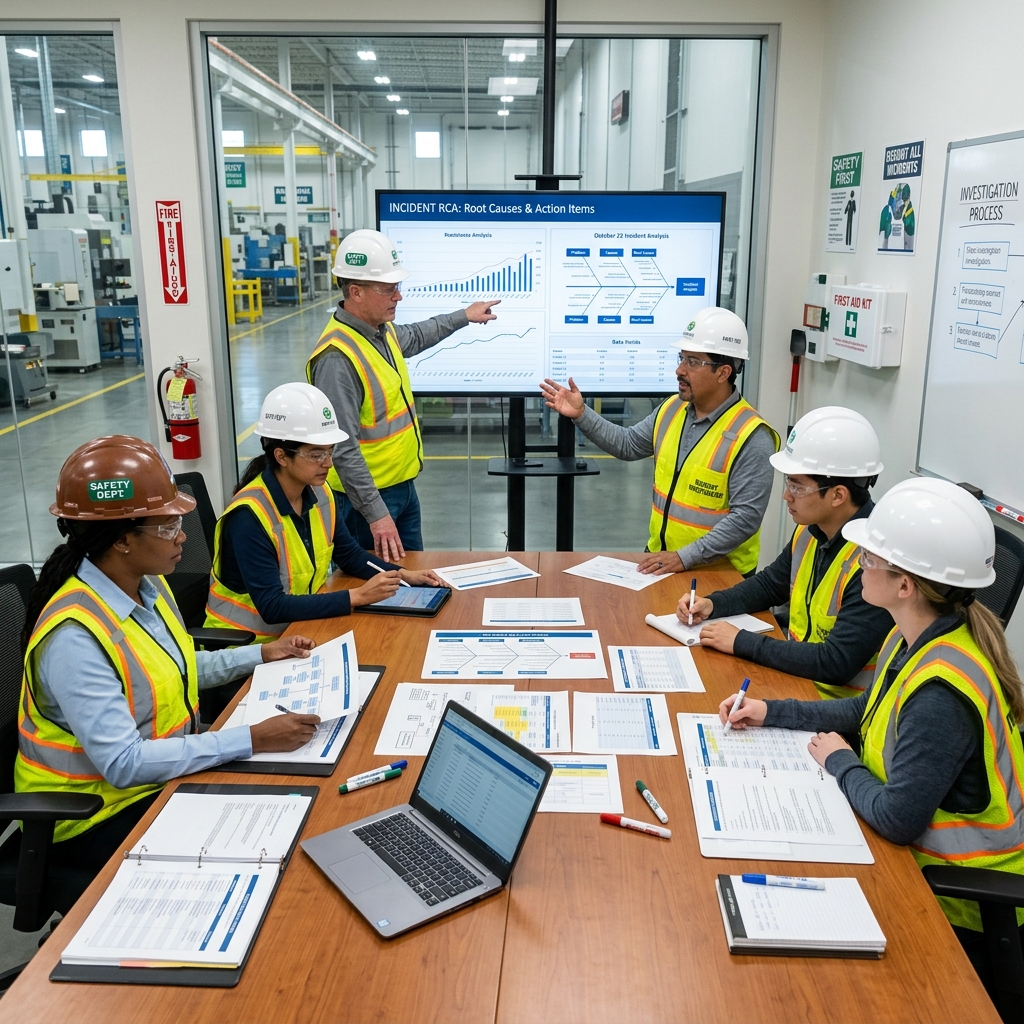
Safety Knights and 3MotionAI Partner to Help Safety Teams Identify and Reduce Movement-Driven Injury Risk
New collaboration connects safety professionals with AI-powered risk intelligence designed to uncover hidden ergonomic and movement-related hazards before injuries occur. [ROCHESTER, NY — APRIL 25, 2026] — Safety Knights, a growing community focused on connecting safety professionals with practical, real-world solutions, today announced a partnership with 3MotionAI, a risk intelligence platform developed by SimpleTherapy that helps organizations identify and reduce movement-driven injury risk across their workforce. Through the partnership, 3MotionAI will join the Safety Knights Preferred Partner Page, giving members direct access to explore how advanced analytics and motion-based insights can strengthen injury prevention strategies. Musculoskeletal injuries remain one of the most persistent and costly challenges in workplace safety, particularly across industries like manufacturing, construction, logistics, utilities, and healthcare. While many safety programs rely on lagging indicators or observational assessments, these approaches often miss the underlying movement patterns and physical stressors that lead to injury over time. 3MotionAI addresses this gap by using AI-powered analysis to evaluate how work is actually performed. By capturing and analyzing movement data, the platform helps organizations identify high-risk tasks, quantify exposure, and prioritize interventions that can reduce strain before injuries occur. Rather than relying solely on reactive measures, 3MotionAI enables safety teams to take a proactive, data-driven approach to ergonomics and injury prevention. The platform provides actionable insights that help organizations redesign work, improve movement efficiency, and reduce cumulative risk across their workforce. Through the Safety Knights partnership, 3MotionAI will gain visibility across the Safety Knights community while also engaging directly with safety leaders looking to modernize their approach to ergonomics and risk management. “Safety teams have been trying to solve musculoskeletal injuries for years, but many are still relying on incomplete data,” said Branden Raczkowski, Director of Safety Knights. “3MotionAI brings a new level of visibility into how work is actually being performed, which allows organizations to identify risks earlier and make more informed decisions. We’re excited to introduce this capability to the Safety Knights community.” By combining Safety Knights’ engaged safety network with 3MotionAI’s AI-driven risk intelligence, the partnership aims to help organizations reduce preventable injuries, improve workforce performance, and build more proactive, data-informed safety programs. Learn More About 3MotionAI https://safetyknights.com/partners/3motionai-risk-intelligence-platform-a-simpletherapy-solution
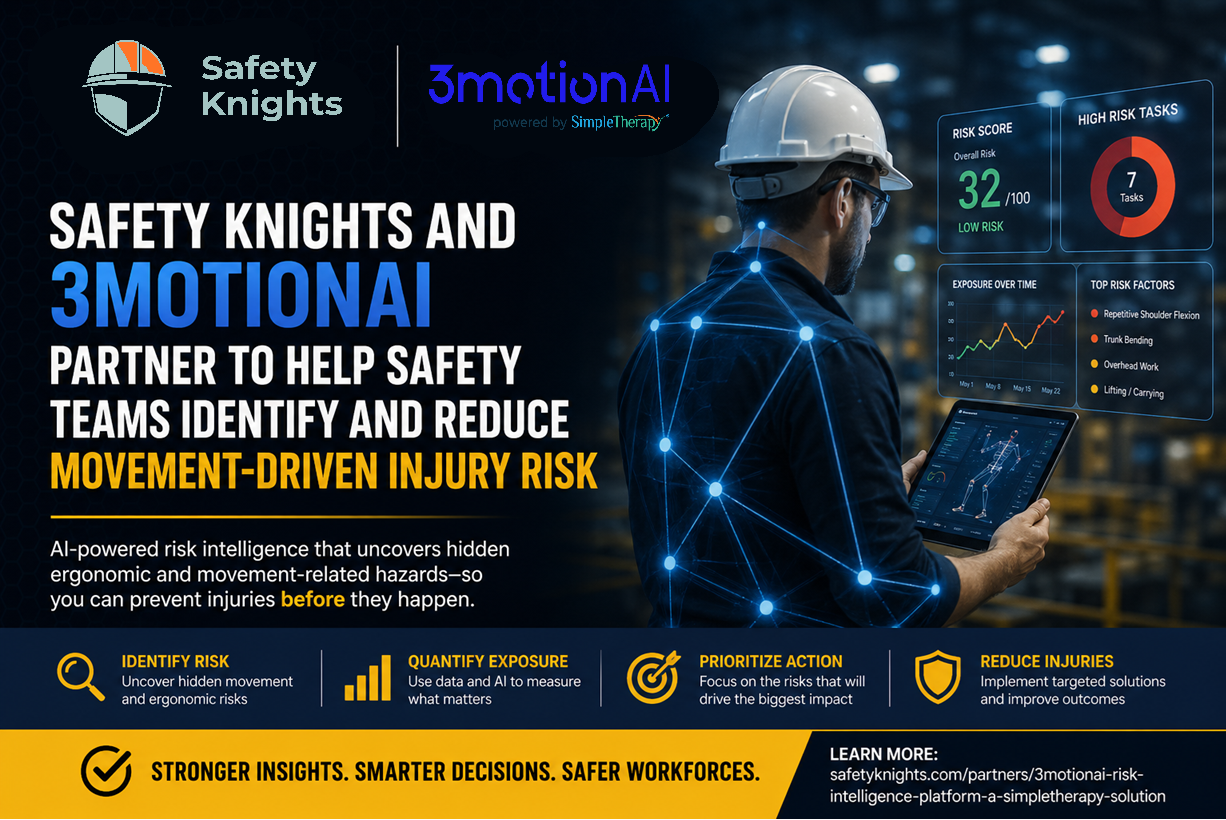
Manufacturing Safety Programs: Building An Audit-Ready Culture
The manufacturing floor presents a unique environment filled with heavy machinery, hazardous chemicals, and constant motion. Protecting the people who keep these operations running requires a systematic approach to risk management. Industrial safety isn't just an administrative checklist required by regulatory bodies. A proactive approach to hazard mitigation builds a resilient workforce and a robust operation. Leaders who prioritize employee well-being often see significant improvements in overall productivity and morale. This guide provides actionable steps for establishing a compliance-driven safety culture that protects your bottom line. Safety professionals carry the heavy burden of ensuring every worker returns home without injury. You need reliable strategies to identify risks before they escalate into costly incidents. Expanding your knowledge base is the first step toward building a safer facility. Safety Knights home: https://safetyknights.com
The Real Cost of Workplace Incidents
Workplace accidents carry a staggering financial and human toll that extends far beyond the initial injury. Recent data indicates that workplace injuries cost United States employers tens of billions of dollars annually. These expenses include medical costs, lost productivity, and increased insurance premiums. A reactive approach to incident management leaves your facility vulnerable to unpredictable operational disruptions. When a machine operator gets injured, production slows down and team morale takes an immediate hit. Fines from regulatory agencies can further cripple a company's financial stability. Taking preventative measures drastically reduces the likelihood of these severe operational setbacks. Investing in a robust safety program always pays off by minimizing costly downtime and material waste. Bureau of Labor Statistics injury data: https://www.bls.gov/iif/The Financial Impact of Non-Compliance
When manufacturing facilities ignore safety regulations, the financial repercussions can devastate the business. Regulatory agencies enforce strict penalties for violations of machine guarding, respiratory protection, and hazard communication standards. A single willful violation can result in fines exceeding six figures, directly impacting your profit margins. Beyond direct fines, non-compliance frequently leads to increased workers' compensation premiums and insurance costs. Insurers closely monitor your incident rates and safety management systems when calculating your coverage rates. A poor safety record signals high risk, causing your premiums to skyrocket year over year. Serious incidents often trigger extensive legal liabilities and civil lawsuits from injured employees. Defending against these claims drains company resources and distracts leadership from core business objectives. Proactive safety investments act as an insurance policy against these catastrophic financial losses. Safety Knights mission: https://safetyknights.com/missionCore Elements of a Resilient Safety Program
Effective manufacturing safety programs rely on a structured framework that addresses specific operational risks. The foundation of this framework begins with clear policies and unwavering commitment from organizational leadership. Without executive support, safety initiatives often fail to gain traction on the factory floor. You must systematically identify and evaluate potential hazards across all production lines and maintenance areas. This requires regular walkthroughs, job hazard analyses, and open dialogue with frontline employees. Documenting these findings creates a clear roadmap for implementing necessary safety controls. Training your staff is another critical pillar of risk management. Employees must understand the specific hazards associated with their roles and how to mitigate them. Safety Knights content: https://safetyknights.com/contentLeadership Commitment and Clear Policies
Senior management must articulate a clear safety vision and allocate adequate resources for its execution. When leaders actively participate in safety walkarounds, it sends a powerful message to the entire workforce. This visible commitment helps foster a culture where safety is viewed as a core organizational value. Developing a comprehensive safety policy document is essential for setting clear expectations. This policy should outline responsibilities for every level of the organization, from the plant manager to the newest hire. Review this document annually to ensure it aligns with evolving regulatory requirements and operational changes. Accountability mechanisms ensure that safety protocols are consistently followed across all shifts. Recognizing and rewarding safe behaviors can be highly effective in reinforcing positive habits. Safety Knights community: https://safetyknights.com/join-usConducting Systematic Risk Assessments
Risk assessments are the diagnostic tools that uncover hidden dangers within your manufacturing processes. Breaking down complex tasks into individual steps makes it easier to spot potential ergonomic strains or pinch points. You can then prioritize controls based on the likelihood and severity of potential injuries. Ergonomic evaluations are particularly vital in environments requiring repetitive motion or heavy lifting. Simple interventions, like adjusting workstation heights or rotating job assignments, can drastically reduce musculoskeletal disorders. These proactive adjustments keep your workforce healthy and productive over the long term. Always involve the workers who perform the tasks daily in your assessment process. They possess invaluable insights into the practical challenges and workarounds that might introduce hidden risks. Safety Knights podcasts: https://safetyknights.com/podcastsNavigating OSHA and ISO 45001 Standards
Compliance with federal and international standards forms the baseline of any legitimate manufacturing safety program. The Occupational Safety and Health Administration mandates strict requirements for machine guarding, confined spaces, and lockout/tagout procedures. Failing to adhere to these regulations exposes your organization to severe penalties and legal liabilities. The ISO 45001 standard provides an internationally recognized framework for occupational health and safety management systems. Its structured approach helps organizations systematically identify hazards and pursue continual improvement. Adopting this standard demonstrates a world-class commitment to protecting your employees. Preparing for regulatory inspections should be a continuous process rather than a frantic scramble. Regular self-audits help you identify compliance gaps before an official inspector arrives at your facility. OSHA hazard communication guidelines: https://www.osha.gov/hazcomUpgrading Your Compliance Training
Outdated or ineffective training modules leave your workforce unprepared for the realities of the factory floor. Modern compliance training must be engaging, role-specific, and accessible to diverse learning styles. Interactive demonstrations and scenario-based learning dramatically improve knowledge retention compared to static presentations. Refresher courses are necessary to keep critical safety protocols top of mind for experienced workers. Complacency is a significant danger in environments where employees perform the same tasks for years. Regular training interventions disrupt this complacency and reinforce the importance of situational awareness. Documenting training completion is essential for demonstrating regulatory compliance during an audit. Implement tracking systems that automatically notify managers when employee certifications are nearing expiration. Safety Knights articles: https://safetyknights.com/content/articlesHazard Communication and Chemical Safety
Manufacturing facilities frequently rely on a complex array of chemicals, solvents, and industrial lubricants. The Hazard Communication Standard requires you to inform employees about the specific chemical dangers present in their work environment. Proper labeling and accessible Safety Data Sheets are non-negotiable components of your safety infrastructure. Managing new chemical introductions is a common challenge that plagues many safety teams. Employees sometimes bring in new cleaning agents or adhesives without notifying the safety department, bypassing necessary risk evaluations. Establishing a strict procurement approval process prevents unauthorized chemicals from entering the building. Spill response training ensures your team knows exactly how to react when a chemical containment fails. Quick and correct action minimizes environmental damage and prevents serious toxic exposures. NIOSH chemical safety: https://www.cdc.gov/niosh/topics/chemical-safety/default.htmlEssential PPE Management Practices
Personal protective equipment is the last line of defense between an employee and a severe workplace injury. While engineering controls are always preferable, protective gear is frequently necessary in complex manufacturing environments. Implementing a reliable safety equipment program requires careful selection, fitting, and maintenance. Managers must ensure that the equipment provided is appropriate for the specific hazards present in the work area. A successful personal protective equipment management system includes several critical components: - Regular audits of current equipment conditions - Mandatory training on proper fitting and removal - Clear policies regarding equipment replacement - Readily accessible storage stations near work zones Employees must understand that wearing damaged or poorly fitted equipment is just as dangerous as wearing nothing at all. Regular inspections help identify wear and tear before a piece of gear fails during a critical moment. Safety Knights written programs: https://safetyknights.com/content/written-programsEffective Lockout/Tagout Procedures
Failure to properly control hazardous energy during equipment maintenance is a leading cause of severe industrial accidents. Lockout/tagout procedures are designed to prevent the unexpected startup of machinery while an employee is actively working on it. A robust program requires detailed, machine-specific written procedures for every piece of equipment on your floor. Authorized employees must be thoroughly trained on how to isolate all energy sources, including electrical, pneumatic, and hydraulic power. Applying a physical lock and informational tag ensures that nobody can accidentally re-energize the system. You must also conduct periodic inspections to verify that these procedures are being followed flawlessly. Standardizing your lockout equipment and utilizing highly visible locks helps prevent confusion during complex maintenance tasks. A zero-tolerance policy for bypassing lockout protocols is necessary to protect the lives of your maintenance personnel. OSHA control of hazardous energy: https://www.osha.gov/control-hazardous-energyThe Role of Technology in Modern Safety Management
Digital transformation is revolutionizing how safety professionals track incidents and manage regulatory compliance. Paper-based checklists and fragmented spreadsheets are highly prone to administrative errors and data loss. Centralized compliance software provides a single source of truth for your entire safety management system. Wearable technology can monitor ergonomic risk factors in real time, alerting workers when they adopt unsafe postures. These connected devices provide safety managers with actionable data to redesign problematic workstations. Predictive analytics can even identify maintenance issues before a machine fails and injures an operator. Mobile applications empower frontline workers to report hazards immediately from the factory floor. This instant communication loop allows maintenance teams to address dangerous conditions before they result in an accident. Safety Knights hustles: https://safetyknights.com/hustlesBuilding a Proactive Reporting Culture
A world-class safety culture relies on open communication and a high volume of near-miss reporting. Employees must feel entirely comfortable reporting hazards without fear of retribution or discipline. When leadership responds positively to hazard reports, it encourages further engagement from the workforce. Investigating near misses provides a free lesson in risk mitigation without the cost of an actual injury. Root cause analysis should focus on systemic failures rather than placing blame on individual operators. Fixing the underlying process ensures the dangerous condition is permanently eliminated. Sharing the results of incident investigations across all departments maximizes the educational value of the event. Transparent communication builds trust and demonstrates that management takes employee concerns seriously.Empowering Frontline Workers
Safety cannot be dictated exclusively from the corporate office or the plant manager's desk. The most effective manufacturing safety programs actively involve operators, mechanics, and material handlers in the decision-making process. Establishing employee safety committees gives your workforce a formal voice in shaping facility policies. When workers help design safety procedures, they are much more likely to follow them consistently. This collaborative approach transforms employees from passive rule followers into active safety champions. Peer-to-peer accountability becomes the norm when the team feels a shared sense of ownership. Providing regular feedback on safety suggestions shows your team that their input drives tangible operational changes. Even if an idea cannot be implemented immediately, acknowledging the contribution maintains positive momentum. Safety Knights videos: https://safetyknights.com/content/videosMeasuring Success and Continuous Improvement
You cannot improve what you do not accurately measure and track over time. Relying solely on lagging indicators like incident rates paints an incomplete picture of your safety performance. Incorporating leading indicators, such as safety training hours completed and hazards corrected, provides a proactive view of your program's health. Visual dashboards help communicate these metrics clearly to both executives and frontline personnel. Displaying progress toward safety goals keeps the entire organization focused on continuous improvement. Celebrate the milestones your team achieves to sustain energy and enthusiasm for safety initiatives. The pursuit of safety excellence is a continuous journey that requires ongoing adaptation. Regularly review your safety management system to adjust to new regulations, equipment changes, and workforce dynamics. This relentless dedication to improvement is the hallmark of a truly resilient organization. Safety Knights milestones: https://safetyknights.com/milestonesFAQ
Many safety professionals encounter similar obstacles when implementing risk management strategies on the factory floor. This section addresses some of the most common questions regarding industrial compliance and hazard mitigation. Review these answers to refine your approach and ensure your facility remains audit-ready.What is the first step in building a manufacturing safety program?
The very first step is conducting a comprehensive gap analysis of your current operations. You must evaluate your existing policies against OSHA requirements to identify immediate vulnerabilities. This assessment provides the baseline data needed to prioritize your initial safety interventions.How often should we update our compliance training?
Compliance training should be updated annually at a minimum, or whenever new equipment, processes, or chemicals are introduced to the facility. Regulatory changes from OSHA may also trigger immediate updates to ensure your workforce stays informed and protected.What are the most common OSHA violations in manufacturing?
The most frequently cited violations in manufacturing typically involve machine guarding, lockout/tagout procedures, hazard communication, and respiratory protection. Conducting regular self-audits in these high-risk areas helps you stay ahead of potential citations.How can we encourage employees to report near misses?
Establish a non-punitive reporting system where workers feel safe sharing information without fear of discipline. Recognize and reward employees who report hazards, and demonstrate visible follow-through by quickly addressing the issues they bring to your attention.What is the difference between leading and lagging safety indicators?
Lagging indicators measure incidents that have already occurred, such as injury rates or workers' compensation claims. Leading indicators track proactive activities like training completion, hazard corrections, and safety inspections that help prevent future incidents.Strengthening Your Safety Foundation
Protecting your workforce requires unwavering dedication, strategic planning, and the right resources. By implementing these foundational practices, you can transform your manufacturing facility into a model of industrial safety. The effort you invest today will ensure a healthier, more productive environment for years to come. Safety Knights home: https://safetyknights.com